Automation Is the Model

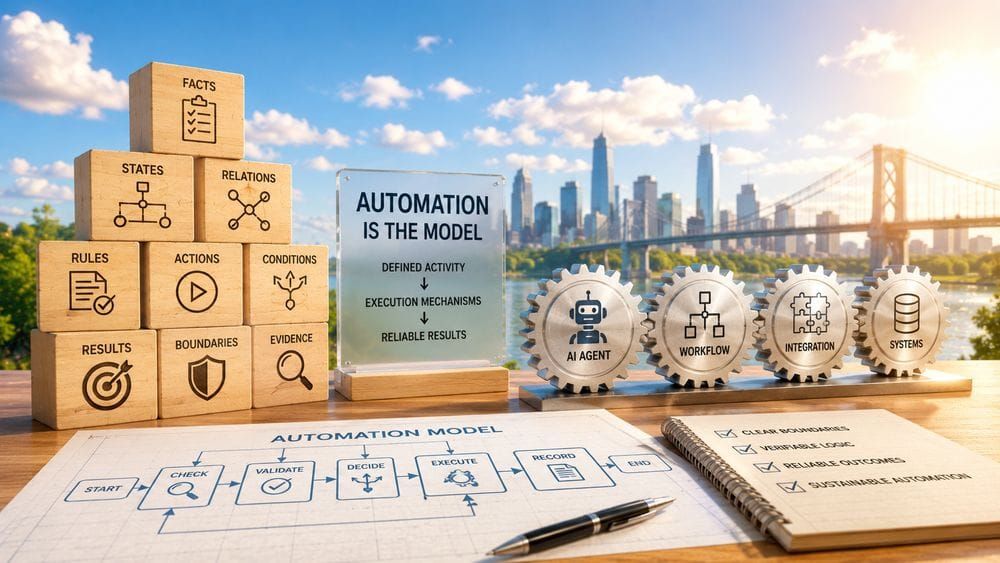
Companies want automation.
They want fewer manual steps, lower operating costs, faster decisions, fewer errors, and work that continues without depending on a particular employee.
A model often sounds like preparation. Automation sounds like the result.
This distinction appears obvious, but it is one of the reasons so many automation projects produce impressive demonstrations without producing dependable automation.
What is usually sold as automation is often only a mechanism of execution:
- an AI agent;
- a workflow;
- an integration;
- a script;
- a software platform;
- a sequence of API calls;
- a new user interface.
These mechanisms can perform actions.
The activity still needs an explicit definition that gives those actions meaning.
The mechanism performs the automation.
The model defines it and preserves its meaning over time.
What Is Usually Sold as Automation
An organization may buy an agent that reads customer messages and calls business systems.
It may buy a workflow that moves data from one application to another.
It may buy an integration that synchronizes records.
It may buy a platform that orchestrates tools, approvals, and notifications.
All of these can be useful.
Together, these mechanisms still require explicit answers to the fundamental questions of automation:
- What activity is being automated?
- Where does that activity begin and end?
- Which facts are required?
- Which sources are authoritative?
- Which states are relevant?
- Which actions exist?
- Under what conditions is each action permitted?
- Which results are valid?
- What happens when information is missing?
- Which situations remain outside the automation?
- Why should a particular result be considered correct?
When these questions remain implicit, the organization has acquired a way to perform operations.
Defined automation begins when these questions have explicit answers.
Execution and Automation
A payment API can issue a refund.
The refund activity becomes automated only when the conditions, facts, actions, and valid results are defined.
A language model can read a request and choose a tool.
The activity still requires an independent definition of entitlement, payment identity, valid amount, prior results, and permitted outcomes.
A workflow can connect several steps.
The model establishes whether those steps represent the correct activity.
An integration can move data reliably.
The model establishes the meaning that the receiving system may rely on.
Execution is the ability to perform an operation.
Automation is the ability to perform a defined activity correctly, repeatedly, and within explicit boundaries.
The difference is the model.
Automation Is the Model
A real automation model defines enough of the activity that its meaning does not need to be reconstructed during every execution.
It establishes:
- what exists;
- which facts are relevant;
- which relationships must hold;
- which states matter;
- what may happen;
- which actions are available;
- what conditions allow or block them;
- which results may follow;
- what prevents execution;
- what evidence must remain afterward.
The model is the structure that makes the automation exist.
A document may explain that structure to a reader.
A program may execute the model.
An agent may interpret part of the input.
A workflow may coordinate several operations.
An integration may connect the model to external systems.
But the model defines what all of those mechanisms mean.
An agent performs actions.
A workflow connects steps.
An integration connects systems.
The model defines the automation.
The model turns an implementation from a candidate into defined automation.
What the Buyer Wants
Organizations should receive a concrete automation result instead of an abstract modeling exercise.
The buyer still wants automation.
The buyer wants a result such as:
- routine requests handled without manual intervention;
- fewer errors;
- lower cost per transaction;
- faster response;
- controlled use of AI;
- a clear audit trail;
- the ability to replace a vendor or model;
- a known boundary of what the system can and cannot do.
The model matters because these outcomes cannot be guaranteed without it.
The buyer can judge the result through coverage, boundaries, required facts, permitted actions, and valid outcomes.
The buyer needs to know:
- what is covered;
- what remains outside the current scope;
- which facts the automation depends on;
- which actions it may perform;
- which results it can produce;
- what happens when required conditions remain unsatisfied.
This is the practical definition of the product being purchased.
The First Product May Be the Boundary
The first deliverable of an automation project may be a verified automation boundary.
The organization may learn:
This part of the activity can be automated now.
This part remains outside the current automation boundary.
These facts are missing.
These rules conflict.
These operations have no reliable contract.
These cases still require interpretation.
That result prevents an expensive mistake.
It stops the organization from buying an agent for an activity that has not been defined well enough for any agent to perform reliably.
This makes automation readiness a real product.
It determines whether the activity is sufficiently modeled for execution.
A buyer should be able to test that claim directly. Terms inside the model must resolve to observable facts, recorded events, linked records, states, or results, instead of phrases that merely sound precise.
The Second Product Is the Automation Model
Once the boundary is known, the next durable result is the model of the activity.
The model begins with the logic of the activity itself.
Current procedure may contain historical accidents, workarounds, duplicated checks, missing integrations, and tasks that exist only because another part of the operation is defective.
The model describes what the activity requires by its own logic.
The company’s existing systems and practices are then compared against it.
Some local differences may be legitimate.
Others reveal defects.
This distinction is essential because automating the current arrangement without examining it merely reproduces the disorder.
A job title is especially dangerous as a unit of automation.
A position often contains whatever accumulated on one person over time.
One employee may perform one process or twenty. That is a staffing decision.
The model must be built around the activity itself:
- its inputs;
- its facts;
- its conditions;
- its actions;
- its changes;
- its results.
Only then can staffing and technology be arranged around something coherent.
The Third Product Is Connection
A general model of an activity is not yet connected to a particular organization.
The next step is to connect it to the company’s actual environment:
- its data sources;
- its applications;
- its external services;
- its policies;
- its contracts;
- its authority;
- its local parameters;
- its technical operations.
This is where the model becomes executable in a real setting.
The organization establishes how its systems and facts correspond to the model.
Where the correspondence is clear, execution can proceed.
Where it is absent, the gap becomes visible before an automated action causes damage.
The Fourth Product Is Controlled Execution
Only after the activity is modeled and connected does the execution mechanism become the central concern.
Different mechanisms may perform different parts:
- conventional software;
- deterministic rules;
- database operations;
- optimization systems;
- AI models;
- human decisions at unresolved boundaries.
The mechanism is selected according to the function.
A language model may interpret an unstructured message.
A deterministic query may retrieve the current state.
A rule may determine that an action is prohibited.
A service may perform the external operation.
A person may resolve a case that remains outside the model.
The automation assigns each mechanism a bounded function inside one defined activity.
The Agent Is Replaceable
This is particularly important in the current AI market.
Organizations are often encouraged to choose a model, build a harness around it, connect tools, and gradually improve behavior through prompting, evaluation, and monitoring.
But language models change quickly.
A new version may interpret instructions differently.
A cheaper model may become sufficient.
A vendor may change pricing or access.
A different model may perform one bounded function better.
If the activity exists only inside prompts and model behavior, replacing the AI component can change the meaning of the automation.
If the activity exists independently as a model, the AI becomes replaceable.
The organization can ask:
- Can another model perform this bounded interpretation?
- Can this step be handled deterministically?
- Can a cheaper mechanism produce the same valid result?
- Can the execution technology change without changing the activity?
That is a much stronger position for the buyer.
The organization owns the automation.
It owns a stable automation definition that can outlast the current agent.
What the Customer Is Really Buying
A complete automation product can therefore be understood as several related assets:
Automation readiness
        ↓
Automation boundary
        ↓
Automation model
        ↓
Connection to local systems
        ↓
Controlled execution
        ↓
Model improvement
The visible system may be an agent, an application, a workflow, or a combination of technologies.
The durable value lies beneath it.
The customer is buying:
- a defined activity;
- known requirements;
- explicit boundaries;
- controlled actions;
- valid outcomes;
- traceable execution;
- the ability to improve the model;
- independence from one execution mechanism.
This creates a more durable asset than a demonstration of capability.
It is automation that can be owned, examined, extended, and transferred.
Why the Model Is a Commercial Asset
A good automation model continues producing value after the first implementation is complete.
It can:
- support more than one application;
- be connected to another organization;
- expose differences among implementations;
- carry corrections to every place it is used;
- identify new automation opportunities;
- reduce repeated analysis;
- allow execution mechanisms to be replaced;
- provide a foundation for future products and processes.
The model is a durable project asset.
It is an accumulating asset.
Each new case can test it.
Each discovered defect can improve it.
Each new connection can extend its usefulness.
Each successful implementation can make the next one cheaper and more reliable.
This is what Experience Capitalization means in commercial terms: repeated use, correction, and extension increase the value of the model.
This is what distinguishes a product from a one-time integration project.
Capability and Defined Automation
A demonstration answers:
Can the system do this once?
Automation must answer:
Under exactly which facts and conditions can this activity be performed, which results are valid, and where must the system stop?
A capable agent may produce a convincing result.
A defined automation can explain why the result was permitted.
A workflow may execute every step successfully.
A defined automation can establish that those were the correct steps for the current state.
A platform may provide excellent tools.
A defined automation determines which tools belong to the activity and what they are allowed to change.
The market has spent years selling execution capability as though it were automation.
The next product category is defined automation.
The Product Is the Automation
The phrase “automation model” can sound like preparation for the real product.
In reality, the model defines the product.
The model defines what the automation is.
The program executes it.
The agent assists inside it.
The workflow coordinates it.
The integrations connect it to the world.
The model remains.
The program executes the automation.
The model is the automation.
Organizations can buy automation as a defined, reusable model connected to executable mechanisms.
When they buy real automation, they acquire a defined model connected to executable mechanisms.