Glages: A Model Factory Built on a Software Factory

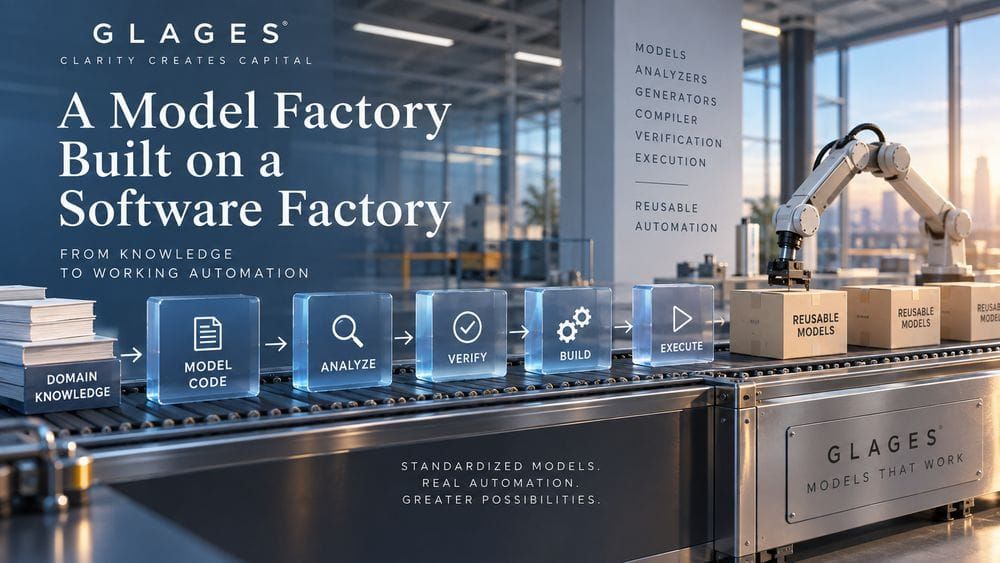
A difficult model can be created once by an exceptional team. A factory has a different objective: make the next hundred and the next thousand models progressively easier to produce, verify, maintain, package, and evolve.
That makes Glages an industrial production problem as well as a formal-model problem. The central engineering principle is:
A model factory should be built on a software factory.
Glages can reuse the mature infrastructure that already exists around programming languages, compilers, runtimes, testing, packaging, deployment, and professional engineering. Its proprietary work can remain concentrated on the new layer: systematic production of reusable Glages Models.
The Strategic Choice Is the Production Environment
A Model Factory depends on much more than syntax. It requires a connected production environment:
language
+
compiler
+
semantic analysis
+
static analyzers
+
source generation
+
runtime
+
libraries
+
testing
+
debugging
+
package management
+
deployment
+
storage
+
professional workforce
The strategic question is which production environment allows Glages Model production to become repeatable, maintainable, staffed, and economically scalable.
The Selected Glages Language Foundation
For the Glages Language, the architecture decision is already made:
C#
+
Roslyn
+
.NET
+
restricted Glages semantics
C# provides the host syntax and type system. Roslyn provides compiler and semantic infrastructure. .NET provides the runtime platform.
Glages defines the narrower semantics that matter to the project: formal concepts, permitted constructs, analyzer rules, verification logic, Model Library contracts, composition rules, specialization mechanisms, diagnostics, Model Adequacy, and production methodology.
The selected platform supplies industrial software infrastructure while Glages defines the formal-model meaning.
The Broader Ecosystem Extends the Industrial Base
C#, Roslyn, and .NET sit inside a much larger Microsoft-centered enterprise software ecosystem. Glages also selects SQL Server as the Factory structured metadata store. Other surrounding Microsoft capabilities can provide infrastructure for development, source control, package management, cloud deployment, identity, enterprise software, collaboration, and AI services where they add value.
The architectural relationship is straightforward:
C#, Roslyn, and .NET are the selected Glages Language foundation. The broader ecosystem provides industrial infrastructure that Glages can use where it adds value.
This lets the Factory benefit from mature surrounding technology while keeping architectural roles explicit. SQL Server is the selected Factory structured metadata store. Other surrounding infrastructure can be used where appropriate, while the semantics of Glages Language and Glages Models remain defined by the Glages formal-model system rather than by those infrastructure products.
Where Glages Concentrates Its Engineering
The Factory can rely on existing mature infrastructure for general-purpose software capabilities and concentrate proprietary engineering on the parts that create Glages-specific value:
- Glages Model production;
- model semantics;
- Program Acceptance;
- Model Adequacy;
- verification and diagnostics;
- composition;
- specialization;
- Model Library evolution;
- production methodology;
- package and release discipline.
This allocation matters economically. Every general-purpose subsystem that already exists is one less subsystem that Glages has to design, staff, maintain, and teach to the developer market.
Human Capital Is Production Infrastructure
Software factories are staffed by people, and model factories will be too. The important question is which work remains scarce after AI assistance, reusable models, and automated verification are introduced.
Glages work can be divided broadly into two categories.
Specialized Glages work includes formal architecture, semantic design, analyzer and verifier design, composition methodology, specialization rules, Model Adequacy methodology, and production-system engineering.
Scalable engineering work includes typed model implementation, tests, diagnostics, tooling, package maintenance, compatibility work, model-library maintenance, and production engineering.
The second category can draw from a mature C#/.NET professional ecosystem. That gives Glages access to established engineering practices, training, and tooling instead of requiring a new general-purpose programming profession around a proprietary language.
The relevant advantage is industrial availability: a mature professional ecosystem, established engineering practices, and long-term tooling.
AI Changes the Labor Mix
AI can further reduce the amount of repeated manual work in model production. It can assist with candidate generation, formal-source drafting, tests, documentation, diagnostic correction, comparison of domain evidence, and exploration of coverage questions.
AI-assisted work feeds the candidate-production stages. Once candidate structure is being formalized, the controlled production path follows the same ordered sequence:
candidate model structure
→ Glages formal representation
→ candidate Glages Model
→ Program Acceptance
→ accepted Glages Model
→ Model Adequacy
→ package construction
→ candidate release package
→ package and integrity checks
→ verified release package
→ Release Eligibility
→ Release
→ released Glages Model
The Model Library begins retaining a model asset when Program Acceptance moves it into the Accepted lifecycle state and continues retaining the same asset after Release moves it into the Released lifecycle state, together with distributable release packages. AI increases candidate-production speed and helps with routine engineering. Automated verification applies repeatable rules at low marginal cost. Specialized human review can then focus on declared scope, adequacy evidence, difficult semantic distinctions, coverage against documented domain evidence, and production-method improvement.
The Economic Goal Is Less Scarce Expert Work per Additional Model
The Factory is not trying simply to minimize headcount. Its scaling objective is more precise:
Reduce the amount of scarce expert work required for each additional model.
The mechanisms are cumulative:
reusable formal concepts
+
Glages Model assets in the `Accepted` or `Released` lifecycle state
+
composition
+
specialization
+
AI-assisted production
+
compiler infrastructure
+
automated verification
+
tests
+
adequacy evidence
+
production methodology
→ less repeated reconstruction
The first model in a family may require substantial architectural work. Later models can reuse formal concepts and structures from Glages Model assets in the Accepted or Released lifecycle state, while relevant tests, diagnostics, and production methods remain separate reusable Factory assets that can also support later production.
That is how model creation starts to become factory production.
Reuse Strengthens Production Economics
The Factory also benefits from reuse. Glages Model assets in the Accepted or Released lifecycle state, verification rules, tests, diagnostics, and other reusable production assets can reduce repeated work in later production.
This cumulative effect becomes important enough to deserve separate treatment. The Model Library and the production system together form a growing capital asset that strengthens later model production.
Long-Lived Assets Need a Mature Engineering Environment
A released Glages Model may become part of software maintained for many years. That makes versioning, debugging, testing, package management, compatibility practices, migration, and long-term tooling important.
A mature engineering platform already has established practices for these problems. Using an existing professional ecosystem reduces the amount of lifecycle infrastructure Glages must create and maintain itself.
The Factory can spend more of its engineering effort on Glages Model production rather than recreating generic software-development capability.
Roslyn Is Particularly Valuable as Factory Machinery
Roslyn is strategically important because it exposes the compiler's semantic representation of source code through APIs. That makes it directly useful for analyzers, diagnostics, source generation, semantic inspection, documentation generation, AI correction loops, and model maps.
The Factory uses C# as the selected host-language foundation and can use Roslyn's programmable compiler infrastructure directly as part of its production machinery.
A Mature Software Factory Under the Model Factory
The industrial logic can be summarized as:
mature software ecosystem
+
professional workforce
+
AI-assisted production
+
programmable compiler infrastructure
+
automated verification
+
reusable models
+
growing Model Library
→ lower repeated production cost
Glages builds a new production layer on top of an existing software-production ecosystem. This allows investment and intellectual effort to remain focused on the scarce problem: turning generalized domain knowledge into reusable Glages Model products systematically.
A model factory should be built on a software factory.
This is an economic architecture principle. The selected software ecosystem supplies mature industrial capability; Glages provides the formal-model technology and the Model Factory production layer.
Sources
- Microsoft Learn, The .NET Compiler Platform SDK
- Microsoft, .NET
- Microsoft, .NET and .NET Core official support policy
- JetBrains, Developer Ecosystem Data Playground