Glages: A Refund Model Is a Reusable Software Product

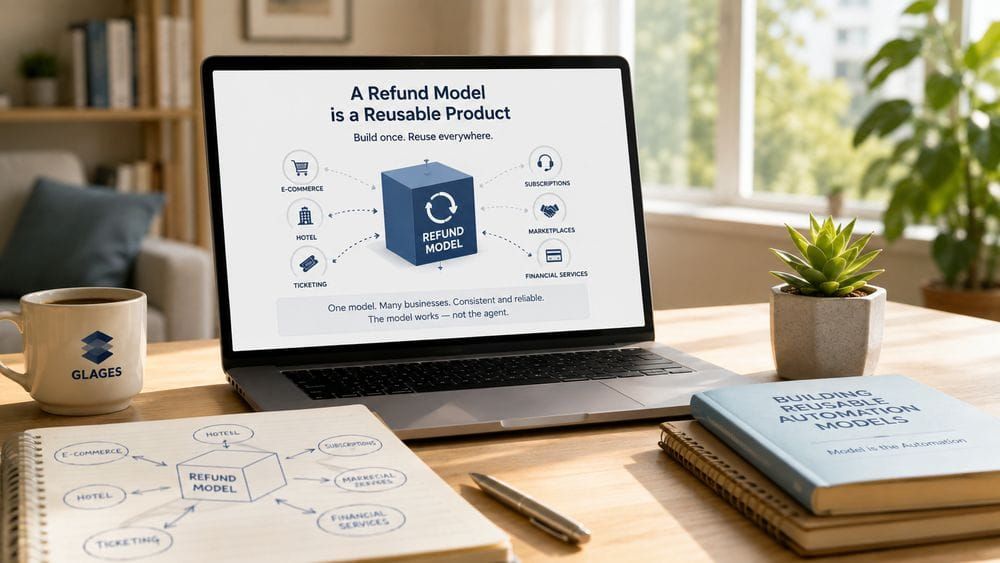
Refund looks simple when described as a button or an API call. In a real business, it is a process with Entities, facts, states, authority, conditions, actions, and several possible results.
That makes refund a useful example of a reusable process model.
The Common Process
A refund request must refer to something that can be refunded. Usually this means a completed payment or an obligation that has already produced a refundable value.
The model must resolve the reference, determine the amount already paid, identify prior refunds, calculate the amount still available, and verify the authority to perform the action.
It must also define possible results. The refund may be permitted and completed. It may be blocked. Additional evidence may be required. No refundable payment may be found. The requested amount may exceed the available amount. The refund may already have been completed.
These are business results, not merely error messages.
What Remains Common
The common refund model can define:
- the refundable source;
- the requested amount;
- the amount already refunded;
- the amount remaining;
- required facts and references;
- conditions that permit or block the action;
- valid refund results;
- the relationship between refund and the original obligation;
- the trace that must be preserved.
Those elements appear across industries.
A retailer may refund an order payment. A hotel may refund part of a reservation charge. A rental company may return a deposit. An insurer may reverse an overpayment. The domain context changes, but the refund structure retains a stable core.
What Belongs to Company Connection
A reusable model should not contain one company’s database fields or provider-specific calls.
The company connection defines which local record represents the payment, which system is authoritative, which field contains the captured amount, which API creates the refund, which roles have authority, and which company parameters affect the rules.
One company may use Stripe, another Adyen, and another an internal payment service. Those differences affect execution but do not redefine what a refund means.
Why Prompts Are Not Enough
A customer may write, “Please return the money for the second item because it arrived damaged.” An LLM can help interpret that sentence, identify candidate items, and extract the requested reason.
It should not decide by itself which payment is refundable, whether the requested amount is available, or whether a return is required. Those decisions depend on the model and verified facts.
The LLM operates inside the approved typed Input. It can resolve bounded language against modeled alternatives. It does not create the refund process during the conversation.
A Reusable Software Product That Can Improve
Once the refund model is used in real implementations, verified cases may reveal missing states or conditions. Perhaps a partial refund interacts with tax in an unexpected way. Perhaps an obligation may be transferred before refund. Perhaps two payment records refer to one business charge.
After review, those cases can strengthen the reusable model and its tests.
The result is not a one-time refund automation. It is a growing reusable software product that can support several markets, organizations, and software applications.
A refund model is reusable because its common meaning is separated from the systems of any one company.