Glages: After Release, a Refund Model Is a Reusable Software Product

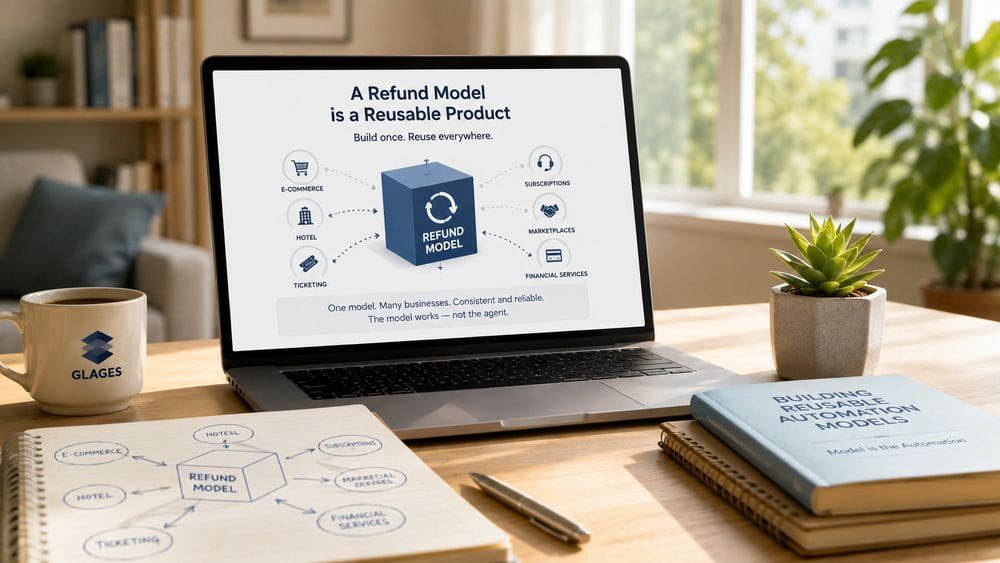
Refund looks simple when described as a button or an API call.
In a real transactional system, refund is a process involving facts, states, authority, conditions, actions, relationships, and several possible results. That makes refund a useful example of what a reusable Glages Model can represent.
The Common Process
A refund request must refer to something that can actually be refunded.
The formal model may need to represent:
- the refundable source;
- the original payment or obligation;
- the requested amount;
- the amount already refunded;
- the amount remaining;
- required references and facts;
- authority;
- conditions that permit or block the action;
- valid refund Results;
- trace requirements.
Possible modeled Results may include:
- refund permitted;
- refund blocked;
- additional evidence required;
- no refundable payment found;
- requested amount exceeds available amount;
- refund already completed.
These are business Results. They are not automatically technical failures.
A correctly executed process can return a negative business Result and still be technically successful.
Why Refund Can Be Reusable
The core refund meaning appears across many markets.
A retailer may refund an order payment. A hotel may refund part of a reservation charge. A rental company may return a deposit. An insurer may reverse an overpayment.
The surrounding domain changes, but important parts of the refund structure remain reusable.
That makes the model valuable as an independent formal asset rather than as logic buried inside one application.
Reusable Model Meaning and Recipient Implementation
A released Glages Model defines the reusable process meaning.
The released Glages Model carries reusable refund semantics, while recipient-specific database schemas, provider accounts, API credentials, internal role names, and deployment architecture belong to recipient application software.
The canonical relationship is:
released Glages Model for refunds
(including its complete machine-readable Formal Model Interface)
→ Distribution
→ Recipient
→ Application
The recipient implements software against the Formal Model Interface and binds its own data sources, APIs, roles, authority bindings where applicable, and execution mechanisms to model-defined contracts.
The released Glages Model for refunds remains the normative formal reference for recipient software.
That means the released Glages Model for refunds defines the formal structure a refund process must satisfy to be represented, verified, and executed by software. A difference observed in a recipient application can indicate a reusable narrower process class suitable for Model Factory specialization, a potentially reusable gap that should be independently reformulated as Domain Evidence for later Factory evaluation, or recipient-specific behavior that remains outside the released model's executable scope.
The Formal Model Interface
The Formal Model Interface is the complete machine-readable public surface of the released Glages Model for refunds.
For a refund model, that surface may expose:
- required refund facts;
- identifiers;
- process
Input; - modeled
Result; - typed
Output; - permitted operations;
- dependencies on payment or obligation models;
- compatibility metadata;
- model identity and version.
This allows recipient software to be checked against the released model rather than relying only on documentation or prompts.
The Formal Model Interface is part of the model product.
It is not a separate integration layer.
After Release, the Model Governs Prompt Interpretation
A user of a recipient application may write:
"Please return the money for the second item because it arrived damaged."
An LLM can help interpret the message, identify candidate items, extract the reason, or structure relevant text.
That does not give the LLM authority to invent the refund process.
The released model defines which facts must exist, which Results are possible, which operations are available, and where execution must stop.
If a required reference cannot be resolved, the application follows the model-defined unresolved-reference or stopping behavior. If the requested amount violates the model-defined refund constraints, the application returns the corresponding model-defined Result or stopping state. If no modeled refund action is eligible in the current Runtime State, governed execution stops within the released model boundary.
From Candidate to Product
A refund model becomes a reusable product through Model Factory production and Release.
candidate Glages Model for refunds
→ Program Acceptance
→ accepted Glages Model for refunds
→ Model Adequacy
→ package construction
→ candidate release package
→ package and integrity checks
→ verified release package
→ Release Eligibility
→ Release
→ released Glages Model for refunds
Program Acceptance establishes formal validity.
Model Adequacy establishes whether the accepted model sufficiently covers the declared refund process class and scope for release.
Only after Program Acceptance, Model Adequacy, package construction, package and integrity checks, positive Release Eligibility, and Release does the model become a reusable product distributed to recipients.
Recipient Observations Enter Through Controlled Model Evolution
A recipient application may encounter a case that appears to reveal a missing process variant or domain-level rule.
A potentially reusable case enters the controlled Model Factory evolution path rather than changing the common model directly.
If an observation appears to have reusable domain significance, it can be independently generalized into Domain Evidence for later Model Factory evaluation. A reproducible abstract case, where useful, participates as Informative Domain Evidence.
recipient application observation
→ independently generalized Domain Evidence
  └── reproducible abstract case where useful as Informative Domain Evidence
→ independent Model Factory evaluation
→ candidate model change
→ Program Acceptance
→ accepted Glages Model
→ Model Adequacy
→ package construction
→ candidate release package
→ package and integrity checks
→ verified release package
→ Release Eligibility
→ Release
→ possible new released Glages Model version
The Factory decides whether the generalized finding represents reusable domain meaning that should enter candidate model work, whether a narrower reusable process class warrants a new specialization candidate, or whether the issue remains specific to the recipient application.
This separation keeps reusable model evolution grounded in independently generalized Domain Evidence and Factory production.
A Reusable Software Product
The value of the refund model is the reusable formal definition itself: it can be licensed and applied across products, markets, and recipient applications while preserving one machine-checkable process meaning.
The same model can support AI automation, conventional software, verification, testing, certification, and other applications.
The product is the released Glages Model itself.
The implementation belongs to the recipient.