Glages: How LLM Makes the Model Factory Possible

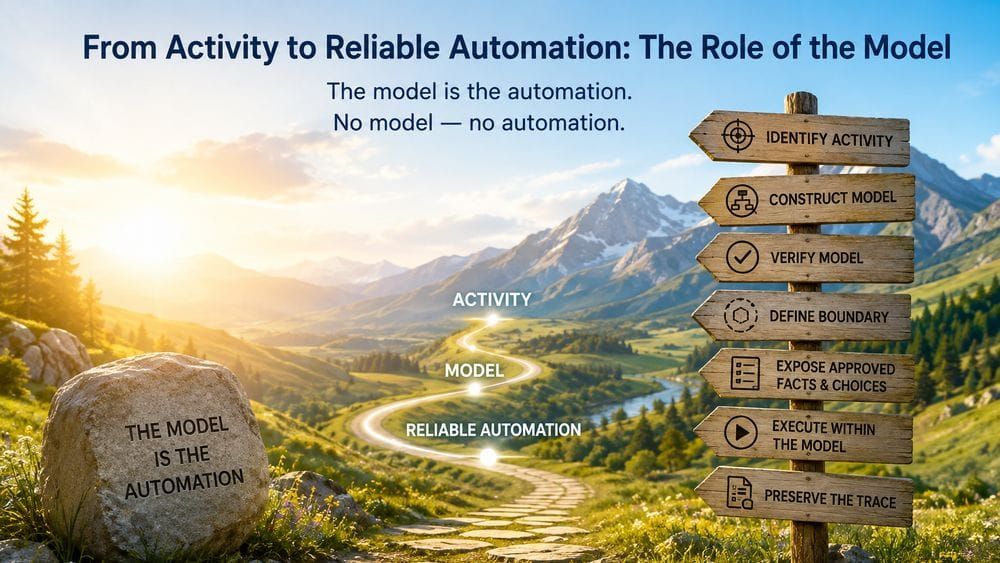
Formal models of business activity have always been expensive to produce. The work requires reading large amounts of material, comparing inconsistent descriptions, finding hidden conditions, resolving terminology, identifying exceptions, and expressing the result in a precise structure.
Large language models change the cost of this work. They do not remove the need for formalization or verification, but they make a model factory economically possible.
The Knowledge Already Exists
Business knowledge is distributed across policies, contracts, manuals, APIs, database structures, software behavior, messages, logs, regulations, and accumulated cases. It also exists in the broad patterns learned by LLMs.
The problem is that this knowledge is not already a verified operational model.
Two documents may use different words for the same concept. One policy may omit a condition that appears in actual software. A common case may be described clearly while a rare but important case appears only in a complaint or exception log.
Human analysts can find these relationships, but the work is slow and difficult to scale.
LLM as a Production Instrument
An LLM can assist with the first stages of model production. It can read source material, identify candidate Entities and states, compare formulations, locate contradictions, suggest relationships, propose model fragments, and help generate tests.
That ability matters because much of the source material is written for people, not for machines. Before a formal model can be built, someone must recognize the possible meaning hidden in the prose and examples.
The LLM makes this recognition and comparison much faster.
Candidate Is Not Model
The output of the LLM remains a candidate.
It may combine concepts that should remain separate. It may infer a rule that is common but not supported by the available sources. It may overlook a rare state or produce a structure that sounds correct while containing an internal contradiction.
The factory therefore separates generation from acceptance.
accumulated knowledge and source material
→ candidate model
→ typed formal representation
→ verification
→ reusable model
→ model library
The candidate must be expressed in a typed formal structure. It must then pass independent checks for consistency, completeness within its stated scope, valid relationships, permitted transitions, and explicit stopping conditions.
The same probabilistic mechanism that proposes a model cannot be the only authority that approves it.
Distillation Rather Than Runtime Improvisation
The usual agent architecture leaves much of the business knowledge in prose and asks the LLM to interpret it during execution. Glages uses LLM capability earlier, during production.
The factory distills broad probabilistic knowledge into a smaller deterministic asset. Once accepted, the formal model becomes independent of the particular LLM that helped produce it.
A more capable model may later improve candidate generation. A cheaper model may handle bounded execution tasks. A conventional program may replace the LLM for some functions. The accepted business meaning remains in the model.
The Economic Change
Without LLM assistance, building a large model library could require too much manual analysis to be commercially practical. With LLM assistance, many recognition, comparison, and drafting tasks become faster.
The difficult work does not disappear. It moves toward resolution, formal construction, verification, composition, and correction. Those are precisely the activities that create the defensible factory asset.
LLM makes the model factory possible because it reduces the cost of extracting candidate structure from accumulated knowledge. Verification determines what becomes a reusable product.