Glages: One Model, Many Uses

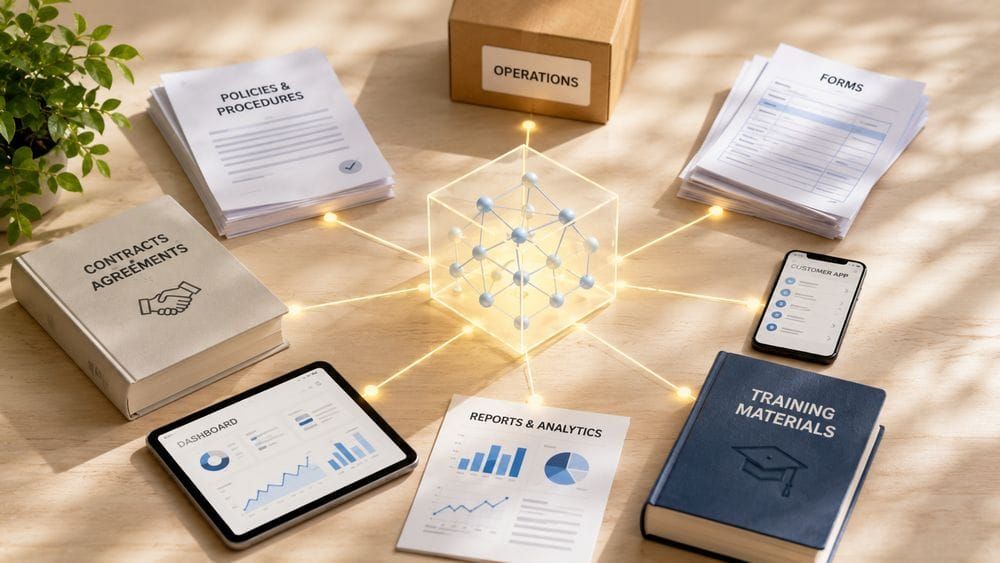
A released process Glages Model is useful during execution, but its value begins before runtime and continues afterward.
The same released Glages Model can support readiness assessment, requirements, testing, controlled execution, self-service, verification, certification, and product design because all of these activities need a common definition of the business process.
Before Development
A released Glages Model can be compared with a licensee's available facts, authoritative data sources, system mappings, and execution mechanisms.
This reveals missing required facts, unavailable authoritative sources, unsupported implementation states, missing mappings, unavailable APIs, and behavior that falls outside the model's declared scope.
The result supports automation-readiness assessment and technological due diligence. A licensee can estimate the real implementation scope before committing to a large deployment.
During Development
The model can define requirements and contracts more precisely than prose alone.
It can identify participating Entities, required Inputs, permitted transitions, valid Results, stopping conditions, and trace requirements. Those structures can guide test cases, acceptance criteria, API contracts, state matrices, and user instructions.
The development team starts from the explicit released Glages Model rather than reconstructing the process independently at implementation time.
During Execution
The model determines which facts are required, which rules apply, which action is permitted, which change is allowed, and which results are valid.
Different interfaces can initiate the same process. A customer may use a website, an employee may use an internal application, and an AI agent may interpret a message. The model preserves the activity across all of them.
This makes transactional self-service possible. The customer is not limited to receiving an explanation; the system can execute a permitted process under the same conditions used elsewhere in the business.
Verification of Documents and Software
Policies, contracts, APIs, data mappings, and software implementations can be checked for conformance with the released Glages Model.
A policy or contract can be checked against the model's explicit authority, facts, conditions, and Results. An API can be checked against the process it claims to support. A software implementation can be tested for conformance with permitted states and changes.
The model becomes a shared reference across representations that are otherwise difficult to compare.
Certification and Compatibility
A released Glages Model can support conformance tests, certification suites, partner-extension requirements, and repeated verification after updates.
A product vendor may allow several partners to extend software around a process. Instead of reviewing each software extension only through informal documentation, the vendor can test whether it remains compatible with the released Glages Model.
New Product Composition
Within the Glages Model Factory, compatible process Glages Model assets in the Accepted or Released lifecycle state can be composed into a candidate model.
reservation
+ payment
+ identification
+ access management
→ contactless check-in
The composed candidate begins with already defined process foundations. Program Acceptance moves a valid candidate into the Accepted lifecycle state; Model Adequacy is then established for the accepted model; package construction produces a candidate release package; package and integrity checks produce the verified release package; a positive Release Eligibility determination permits Release; and Release moves the model into the Released lifecycle state, where it becomes a reusable product.
Organizational Redesign
Applying a released Glages Model may also reveal manual work created by legacy software limits rather than by the modeled process itself. Duplicate checks, unnecessary handoffs, and informal workarounds become visible when the current implementation is compared with the model.
The licensee can then distinguish implementation constraints from model-defined process requirements. If generalized domain evidence reveals a genuine model coverage issue, that becomes a separate Model Factory evolution question.
One released Glages Model supports many uses because each use depends on the same thing: a machine-checkable definition of the activity.