Glages: One Process Model, Many Markets

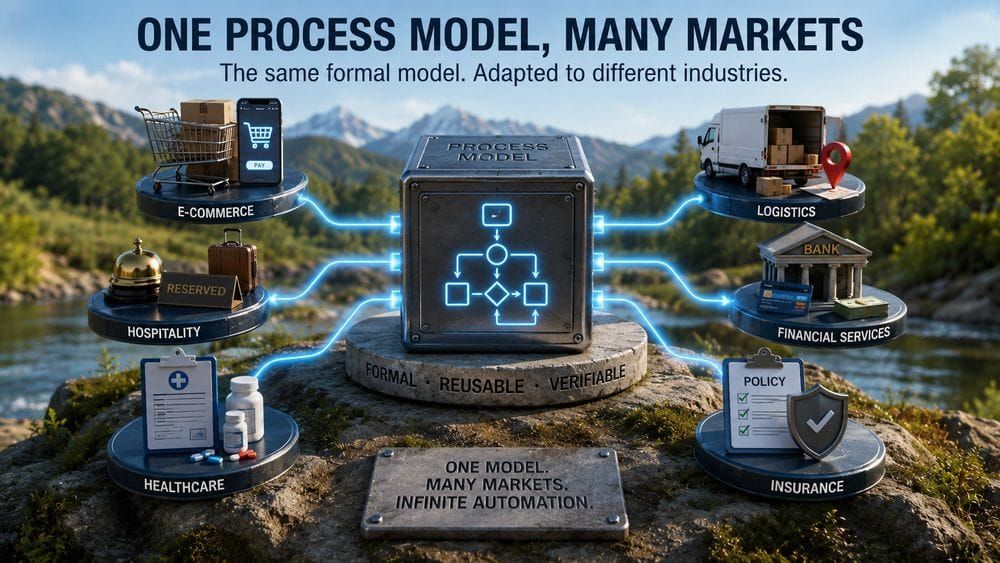
Most automation is priced and built as a single implementation. A team studies one company, creates one solution, connects it to one environment, and then repeats much of the same work for the next client.
A reusable process model changes that economic structure.
Once a process Glages Model has passed the relevant factory gates and is released, the same model can participate in many business domains and products and can support many licensees. Its value is no longer tied to a single implementation.
Refund Is Not an E-Commerce-Only Process
Consider refund. It appears in retail, hospitality, equipment rental, marketplaces, insurance, travel, repair services, and logistics.
The surrounding business changes, but many questions remain stable:
- What payment or obligation is the refund connected to?
- What amount remains refundable?
- Has a refund already been completed?
- Which facts are required?
- Which conditions permit or block the action?
- What result must be recorded?
These common questions form the reusable process model.
A hotel implementation may supply reservation and cancellation facts to the model. A retailer may supply order and return facts. An insurer may supply claim-payment facts. The surrounding systems and records differ, while the released refund Glages Model preserves the common process semantics and determines which modeled facts, conditions, and actions apply.
Reuse Across Business Domains
The same process model can participate in several composed business-domain models.
refund model
→ e-commerce model
→ hospitality model
→ rental model
→ insurance model
→ repair-services model
The economic value of the model can extend across additional domains because its stable core has already been produced and verified and can be reused through controlled Composition.
The new model-production work lies mainly in Composition: defining how refund relates to the other processes in that domain. After Release, each licensee can connect its own systems and execution mechanisms to the model without redefining the common process.
Reuse Across Licensees and Products
After Release, a process Glages Model may support different types of licensees.
A vertical-software company may use it inside a market-specific product. A system integrator may use it as the common foundation for several implementations. An enterprise-software vendor may use it to extend an existing platform. A verification company may use it to test whether policies, APIs, and software correctly support the process.
The same model may also support different products: customer self-service, an employee application, an AI interface, a compliance tool, a test suite, or a complete transactional backend.
The reuse chain is therefore larger than repeated deployment of the same application.
one released reusable process Glages Model
→ multiple business domains
→ multiple licensees
→ multiple products
→ multiple licensee implementations
→ recurring model value
Why Formal Structure Matters
This reuse is possible only when the common meaning is actually expressed in the model.
A collection of prompts is difficult to reuse because its meaning depends on context and interpretation. A workflow built around one company’s field names is difficult to move because the company-specific representation has become part of the process definition. A prose policy can be copied, but it still has to be interpreted during every implementation and often during every execution.
A formal model separates common meaning from local representation. It can be checked independently of the first implementation and connected to new environments without redefining the process each time.
A Different Production Asset
The economic asset is not one completed automation project. It is the released, reusable Glages Model product that can support many projects.
Application observations may identify candidate gaps or questions, but the common model changes only through controlled Model Factory evolution grounded in generalized domain knowledge and factory verification. Later released versions can therefore incorporate verified improvements without absorbing local company-specific practice into the model.
The result is a production system in which model-production work accumulates as reusable assets rather than disappearing into isolated implementations.
After Release, one process Glages Model can serve many markets because it is available as an independent reusable product.