Glages: Structural Meaning Makes a Model Precise

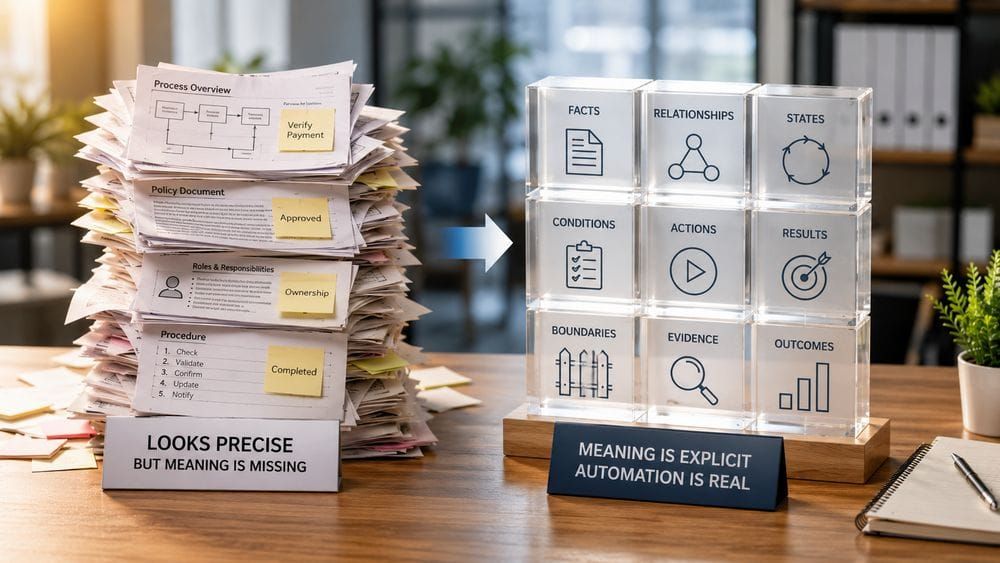
Organizations are full of words that sound precise.
A process may contain a step called Verify Payment.
A database may contain Approved = true.
A workflow may move an item into Completed.
A policy may refer to an Eligible Customer.
An AI agent may be instructed to perform a Valid Refund.
These labels create an impression of formal meaning.
But a name is not the same thing as a model.
The important question is not whether the terminology sounds exact.
The important question is whether the meaning is carried by explicit, machine-checkable relationships.
In Glages, precision comes from structural meaning.
That structural meaning is what allows a Glages Model to function as a machine-checkable automation model and reusable software asset rather than only as descriptive documentation.
A concept is useful when the model defines how it relates to entities, facts, states, conditions, rules, actions, results, and boundaries.
Names Are Helpful, but Names Are Not Meaning
Human-readable names matter.
They make models understandable.
They make software easier to inspect.
They allow people to discuss concepts.
But a label can hide missing semantics.
Consider:
Payment Verified
That phrase might mean:
- a payment record exists;
- authorization succeeded;
- capture succeeded;
- funds settled;
- the payment belongs to the order;
- the amount matches;
- the processor reports a particular state;
- a human reviewed the transaction;
- several of these conditions together.
Without explicit structure, two people can read the same label and apply different rules.
A software system can also carry the label without carrying the intended business meaning.
Precision therefore cannot depend on vocabulary alone.
Structural Meaning
A model becomes more precise when the relevant relationships are explicit.
Instead of relying on PaymentVerified, a formal model may represent relationships such as:
Payment
→ belongs to Order

Payment
→ has current State

RequiredAmount
→ compared with CapturedAmount

Fact
→ supplied under required Authority Class

Condition
→ evaluates model-defined Facts and State

Rule
→ produces Allowed / Blocked / Required / Produced outcome
Now the meaning does not live only in the phrase.
It lives in the structure.
A human-readable name can still describe the concept, but the name is no longer doing all of the semantic work.
The Renaming Test
A useful thought experiment is to replace familiar labels with neutral identifiers.
Suppose:
ApprovedRefund becomes R17.
EligibleCustomer becomes E04.
VerifiedPayment becomes S09.
Would the model still preserve:
- the same required Facts;
- the same relationships;
- the same Conditions;
- the same permitted Actions;
- the same Results;
- the same boundaries?
If yes, much of the meaning is structural.
If no, the model may be depending too heavily on persuasive terminology.
The test is intentionally uncomfortable.
A label like Approved feels meaningful because humans associate it with a decision.
But if the model cannot explain what makes the state valid, who or what can establish it, what facts it depends on, what it permits, and what follows from it, the label is doing the work that the structure should do.
Precision Requires Typed Relationships
Structural meaning is more than linking boxes with arrows.
The relationships themselves need semantics.
A Glages Model uses typed concepts such as:
Entity;Process;State;Fact;Condition;Rule;Action;Change;Result;Decision;Trace.
These types allow different relationships to mean different things.
A Fact is not the same as a State.
A Result is not the same as a technical exception.
An Action is not the same as permission to perform it.
A Condition is not the same as a narrative explanation.
A Rule connects formal Conditions to formal outcomes.
This typed structure allows analyzers and runtimes to inspect meaning directly.
Precision Requires Scope
A model can be precise and still be limited.
That is not a defect.
A refund model may support card-payment refunds but not cryptocurrency refunds.
A verification model may support documents from one class of authorities but not another.
A shipment model may represent parcel delivery but not freight forwarding.
Precision requires the model to state its declared scope rather than imply universality.
The model must also make unsupported situations visible.
If a request falls outside the exact applicable model artifact, the correct outcome is not to stretch the model by interpretation.
A conforming runtime rejects operations, states, transitions, and Results that are absent from the applicable artifact. Where the model defines an explicit clarification or non-execution path for an in-scope unresolved case, that path can be used instead.
Explicit scope is part of structural meaning.
Precision Requires Authority Contracts Where Facts Depend on Source
Some facts matter differently depending on where they came from.
A customer statement may be informative.
A payment processor may be the required source for transaction state.
A regulator may establish a governing requirement.
A certification source bound to the required model-defined Authority Class may supply a certification fact.
The model therefore cannot treat every assertion as equivalent merely because its text is plausible.
Where fact standing depends on source, the governing standing of the external source comes from its applicable real-world status. The model represents the required Authority Class and fact-authority contract that the source must satisfy.
Deployment binds a concrete source to that model-defined role through controlled Contextual / Reference State.
Runtime evidence can then show that the fact was supplied through the source currently bound to the required Authority Class.
This is structural precision.
The model does not merely say Verified.
It defines what kind of fact is required and how its source standing is established.
Precision Requires Separation of Stable Structure and Runtime State
Another source of ambiguity is mixing permanent model meaning with current case values.
Suppose a refund threshold is already a modeled parameter dimension.
Changing its current configured value is a Runtime State change, typically within controlled Contextual / Reference State, provided the exact model already defines that parameter dimension and its permitted semantics.
Adding an entirely new rule that changes what refunds are valid is a model change.
Glages uses the governing distinction:
If a change alters the modeled space of valid Entity types, relationships, states, Process types, rules, operations, or Result values, it is a model change. If the model already defines the dimension and its permitted semantics, changing a concrete value is a state change.
This boundary makes the model easier to reason about.
The exact applicable artifact preserves stable formal semantics for that model version.
Runtime State supplies current values.
Configuration selects among meanings already represented in the model.
It does not create new meaning.
Precision Requires Results, Not Only Actions
Many automation descriptions focus on what the system can do.
A precise model also defines what can result.
Consider a payment attempt.
Possible business Results might include:
- approved;
- declined;
- blocked;
- required evidence missing;
- duplicate request.
A request that is truly outside the applicable model artifact is different. It is rejected as outside the model-defined space rather than represented as an invented business Result.
A network timeout is different.
A malformed response is different.
A software crash is different.
Those are technical failures, not necessarily business Results.
If all non-success paths collapse into Error, the model loses operational meaning.
Glages therefore treats Result space as part of the formal structure.
A model can distinguish what the business process concluded from whether the software mechanism worked correctly.
That distinction is essential for automation, verification, and Trace.
Precision Requires Boundaries
A formal model is not precise merely because it can produce answers.
It is precise when its structure also defines when execution cannot proceed and when a request lies outside the model-defined space.
The model should make missing requirements explicit and distinguish modeled non-execution from true out-of-scope requests.
An in-scope candidate execution may be unable to proceed because:
- required Facts are absent;
- a reference cannot be resolved;
- an Action remains ambiguous under the model;
- authority requirements are unsatisfied;
- another model-defined prerequisite is not met.
Those cases may produce explicit model-defined non-execution or clarification Results.
A request for an operation, State, transition, or Result that does not exist in the applicable artifact is different. It is outside the model-defined space and must be rejected rather than converted into an invented Result.
A system that preserves this distinction is more precise.
Refusal is therefore part of model value. A Glages Model is useful not only because it defines permitted Results and operations, but also because a conforming runtime can deterministically reject requested meanings, actions, transitions, or Results that are absent from the applicable model.
The boundary is part of the model.
Documentation and Formal Models Have Different Jobs
Natural-language documentation remains valuable.
It can explain why a process exists.
It can provide context.
It can help humans understand examples and intent.
It can describe sources and rationale.
But prose tolerates interpretation.
A Glages Model has a different responsibility.
Its important operational meaning must be represented in a structure that can be inspected and checked.
This is why Glages Models are code.
Typed C# representation allows:
- compiler checks;
- analyzers;
- generators;
- deterministic validation;
- model interfaces;
- tests;
- package verification;
- runtime enforcement where execution is required.
The formal model is therefore more than documentation about the process.
It is a machine-checkable software asset. In the Glages automation architecture, the model itself is the automation in the sense that it defines the stable process meaning, permitted operations, required facts, Results, and boundaries. Execution Mechanisms supply the capability that acts within that model-defined automation.
AI Can Produce Precise-Looking Language Without Precise Structure
Large language models are extraordinarily good at generating convincing terminology.
They can produce policies, workflows, schemas, taxonomies, state names, and process descriptions that look coherent.
That ability is useful during model production.
It is also a reason to separate fluent candidate generation from formal acceptance.
An LLM may propose:
PaymentStatus = Verified
That tells us very little by itself.
The production system still needs to ask:
- What Entity owns this State?
- What Facts establish it?
- Which Authority Class is required?
- Which Conditions depend on it?
- Which Actions does it permit?
- Which Results can follow?
- What happens if required facts conflict?
- What scope does the structure cover?
The LLM can help propose answers.
The accepted model must represent them explicitly.
Program Acceptance and Model Adequacy Test Different Things
A candidate can be structurally valid without being a sufficient product.
Compilation and analyzers may establish that the candidate conforms to the Glages Language and selected program rules.
That is not the same as showing that the model adequately covers its declared process class.
Model Adequacy asks broader questions:
- Are important variants represented?
- Are exception paths covered?
- Are failure paths explicit?
- Are binding constraints satisfied?
- Are boundaries clear?
- Is the declared scope supported?
This matters to precision.
A beautifully typed model can still be incomplete.
Formal correctness and domain adequacy are related but distinct.
Precision Survives Mechanism Changes
A strong test of structural meaning is whether the model remains valid when the execution mechanism changes.
Suppose an LLM performs document interpretation today.
A specialized classifier may perform it tomorrow.
A deterministic parser may perform part of it later.
The stable model should continue to define:
- what Input is required;
- what output categories are permitted;
- what validation applies;
- what downstream Actions are allowed;
- what Result space exists.
The mechanism can improve without redefining the process.
This is one of the reasons Glages separates Stable Formal Structure, Runtime State, and Execution Mechanism.
The model preserves meaning.
The mechanism supplies capability.
Structural Precision Makes Reuse Possible
A model whose meaning depends on local names and undocumented assumptions is difficult to reuse.
A model whose semantics are explicit can travel farther.
A released reusable payment model can be applied across multiple business domains within its declared scope.
A released reusable refund model can support multiple recipient implementations within its declared scope.
A verification model can become a reference for conformance testing and certification.
Reuse depends on the ability to know what the model actually means.
That requires more than familiar labels.
It requires explicit structure.
The Practical Standard
When evaluating whether a model is precise, ask:
- Are the important concepts typed?
- Are the relationships explicit?
- Are possible States defined?
- Are required Facts identifiable?
- Are authority requirements represented where needed?
- Are Conditions and Rules machine-checkable?
- Are permitted Actions distinct from mere technical capability?
- Are Results explicit?
- Is declared scope clear?
- Are unsupported situations visible?
- Does the meaning survive renaming?
- Can analyzers and software inspect the structure directly?
If the answer is yes, the model's precision comes from its structure.
If the answer is no, precise terminology may be hiding semantic gaps.
Glages therefore uses a simple principle:
The label helps humans read the model. The structure carries the meaning.
That is what turns a precise-looking model into a precise formal model.