Models as Experiential Capital

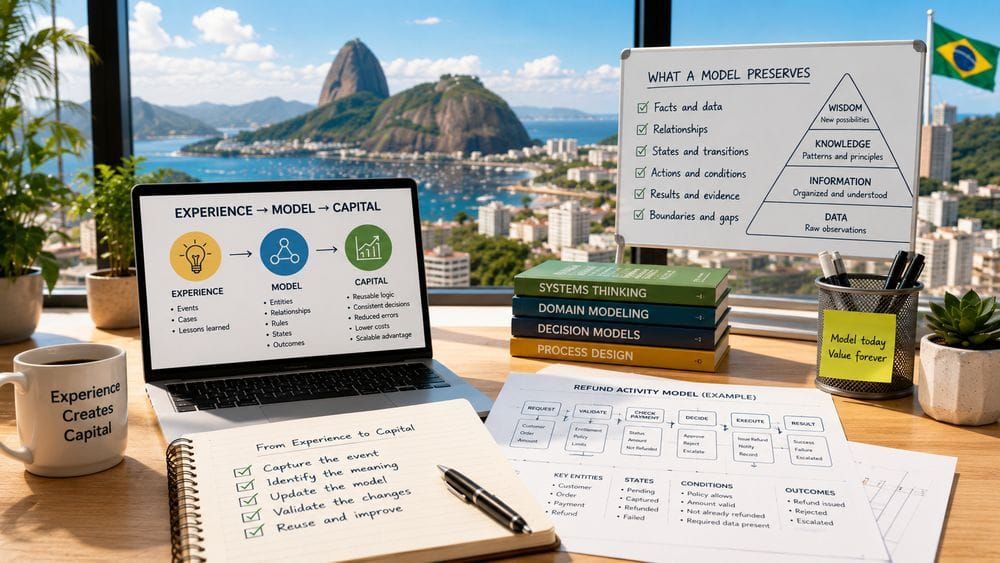
People often ask what Experience Capitalization actually looks like in practice.
The idea sounds clear at an abstract level: work creates experience, and that experience should become an asset instead of disappear. But what is the asset itself? Where does it exist? What can an organization point to and say: this is our Experiential Capital?
Stories, meeting notes, transcripts, and employee memories can preserve evidence. Experiential Capital becomes most useful when that evidence changes a system of models.
A model captures what has been learned about something well enough that the learning can be used again. It identifies the relevant things, their relationships, the states they can be in, what may happen to them, what conditions matter, what results are possible, and where the limits of current understanding remain.
When experience changes a model, the organization can reuse the logic instead of rediscovering it each time. The model becomes a reusable result of previous work.
That is Experience Capitalization in a real form.
From Experience to Capital
Work always leaves something behind.
A customer case may reveal that a rule is incomplete. A failed implementation may expose a hidden dependency. A successful process may confirm that a certain sequence works. A new product may show that two previously separate ideas can be combined. A scientific analysis may reveal a relationship that no individual study established on its own.
All of this is experience.
Experience becomes capital when it changes something durable and reusable.
It may remain in one person's memory. It may be buried in an email, a ticket, a document, a code comment, or a conversation. It may be remembered only as a vague feeling that one approach is safer than another.
In that form, experience is fragile. It is difficult to verify, difficult to transfer, and difficult to apply consistently.
Capital requires a more durable form.
The experience must change something that can continue to work after the original situation and the original person are gone.
A model provides that form.
What a Model Preserves
A model preserves the parts of an event that matter for future use.
For a repeated business activity, a model may preserve:
- what objects are involved;
- which facts are required;
- which states are possible;
- what actions may occur;
- which conditions permit or block those actions;
- what results can follow;
- what must remain traceable;
- what is still unknown or unresolved.
For a product, a model may preserve its parts, functions, constraints, dependencies, and possible modifications.
For a scientific domain, a model may preserve known entities, observations, relationships, conditions, and competing explanations.
For a creative or engineering problem, a model may preserve the existing elements from which new variants can be constructed.
A written instruction may say, “Verify the payment before issuing a refund.”
A model must make clear what counts as a payment, what state confirms it, which refund refers to it, what facts are required, what prevents a second refund, and what result follows.
The instruction records a sentence. The model preserves the operational meaning.
This leads to a practical rule:
No physical referent — no meaning.
A term in a model is meaningful only when it points to a single, checkable fact in the world or in an external system.
“Verify the payment” lacks a physical referent until it identifies what must be observed.
payment.status == Captured does.
“Strong communication skills” functions as a container phrase without a physical referent.
“A response was sent to the identified recipient within the required time” does.
A model relies on terms that resolve to something observable, checkable, or traceable. Every term must resolve to something that can be observed, checked, or traced.
Organizational Knowledge and Missing Models
Organizations are often said to possess hidden or tacit knowledge that exists only in the minds of experienced employees.
For routine operational activity, this description often points in the wrong direction.
What appears to be secret organizational knowledge often consists of ways to compensate for a missing model.
Employees know which field cannot be trusted, which instruction should not be followed literally, which status must be checked in another system, whom to contact when the formal process fails, and which manual action prevents an invalid result.
They possess practical knowledge of where the company’s systems and procedures fail to form a coherent model.
This becomes visible even before a person joins the company.
Job advertisements frequently ask for “strong communication skills,” “the ability to work in a fast-paced environment,” “ownership,” “cross-functional collaboration,” or “comfort with ambiguity.”
These phrases describe a desired personality while leaving the processes, required facts, permitted decisions, and expected results unclear.
The candidate is therefore expected to supply the missing structure personally.
The same phenomenon appears inside operations. A person becomes valuable because they know how to bridge disconnected systems, interpret vague instructions, and prevent errors that the formal process does not prevent.
This experience is real. Much of it functions as compensation for an incomplete system.
Its value lies in showing where the model is absent, incomplete, or incorrectly implemented.
The best capitalization uses the workaround as evidence, identifies the missing logic, and removes the need for the workaround.
Experience Capitalization therefore evaluates what each habit has revealed before deciding what deserves preservation.
It means deciding what the experience has revealed and changing the model accordingly.
Models of Activity
A company improves its operations through models of the activities in which it participates.
It needs models of the activities in which it participates.
A refund, a payment, an order, an approval, a shipment, a hiring decision, a publication, or a product change has a logic that is not invented separately by every company.
Organizations may use different systems, thresholds, roles, contracts, and local facts. But the underlying activity still contains recognizable objects, states, conditions, actions, and results.
The model describes that activity.
The company then connects its actual environment to the model:
- its data;
- its systems;
- its authority;
- its policies;
- its external operations;
- its local parameters.
This distinction prevents a serious mistake.
The purpose is to capture the logic of the activity instead of every historical way in which the company happens to work. That would turn old workarounds, accidental structures, and poor automation into permanent design.
The purpose is to model the activity clearly and then determine where the company's current operation corresponds to that model and where it does not.
Where it corresponds, the activity can become reproducible.
Where it does not, the difference becomes visible.
This point deserves emphasis because the relationship is easy to invert. A model built by recording current practice would formalize the company's dysfunction as if it were the standard. Current practice provides evidence, while the model captures the activity’s logic.
A model of a refund, an approval, or a hiring process describes what the activity requires by its own logic, independent of any single company's accumulated workarounds. The company’s current practice is then compared against that model.
Where practice diverges, the difference deserves examination and often correction.
Process, Not Position
A process is the useful unit of activity.
A position such as “manager” often collects several unrelated processes under one title. It may simply name whatever accumulated on one person over time, for reasons that had little to do with deliberate design.
One person may legitimately perform one process or twenty. That is a staffing decision.
The model belongs at the level of the process: its inputs, conditions, actions, and results. A job title remains a staffing container whose contents may change over time.
Models Make Automation Possible
Automation projects often begin with a tool, an agent, or an integration.
A company chooses a workflow tool, an AI agent, a software platform, or an integration project and then tries to fit the work into it.
The model usually remains incomplete.
People continue to supply the missing meaning: they decide which facts matter, interpret exceptions, connect records, and prevent invalid actions.
This is why so much automation remains human-machine automation. The software performs isolated operations, while people preserve continuity between them.
Attempting to automate a job title inherits its accidental structure. This is one of the quiet reasons so many automation projects fail even before AI: they automate the shape that happened to exist, not the activity that should exist.
Automating disorder produces disorder at greater speed and scale.
A formal model changes the order.
First, the activity is represented clearly enough to determine what exists, what may happen, and under which conditions.
Then a program, a service, a person, or an AI system can perform a part of that activity inside the model.
Automation becomes the execution of a model instead of an attempt to reconstruct one while acting.
This is the first practical use of Experiential Capital.
Previous work has established and refined the model. Future work can use it without starting from zero.
The organization has capitalized its experience because what was learned now reduces the cost, ambiguity, and risk of later execution.
Models Also Make New Creation Possible
Models support repeated activity and provide a foundation for making something new.
New things rarely appear without relation to what already exists. They are usually produced by one or more of the following:
- modifying an existing element;
- combining existing elements;
- transferring a known principle into another setting;
- removing an old constraint;
- changing scale, sequence, material, or context;
- discovering a relationship among facts that were already known separately.
The phrase “everything new is well-forgotten old” misses the main point. New work usually transforms what is already known.
That transformation becomes easier when the existing material is modeled.
A model shows what parts exist, which properties are essential, which relationships hold, what can change, and what consequences a change may produce.
Without models, the creator must repeatedly reconstruct the existing world before attempting to change it. Much of the work that appears creative is spent rediscovering definitions, dependencies, limits, and previous failures.
With models, attention can move to the transformations themselves.
The questions become more precise:
- What happens if this element is replaced?
- Can these two models be combined?
- Is a constraint fundamental or merely historical?
- Can a process from one domain operate in another?
- Can the result of one activity become the input of another?
- Which valid combinations have never been tested?
- Which known facts form a relationship that no one has modeled yet?
A system of models therefore creates a structured space for new candidates.
It creates a structured space in which new results can be constructed and evaluated with less dependence on chance.
Discovery From Existing Work
Science already provides familiar examples.
A new finding may emerge from existing experiments and observations. Researchers may analyze a large body of completed studies and discover a pattern, contradiction, dependency, or relationship that no individual study revealed.
The underlying observations already existed.
The discovery came from putting them into a better model.
The same principle applies outside science.
A company may already possess all the facts needed for a better product, process, or decision, but those facts remain divided among departments, software systems, documents, and individual cases.
Systematic creation becomes possible once their meaning and relationships are represented together.
When existing knowledge becomes a connected system of models, new combinations become visible.
The volume of stored information matters less than the structure that makes it usable.
Models Must Continue to Change
A model is a current, testable statement about the world.
Work continues to test it.
A process may encounter a case the model does not cover. A product may reveal an unexpected dependency. A decision may produce a result that contradicts an assumption. A new combination may expose a missing category. An external change may make an old condition invalid.
These events create new experience.
Experience Capitalization occurs when that experience is used to:
- confirm the model;
- correct it;
- extend it;
- narrow its scope;
- replace part of it;
- identify a defect in its implementation;
- create a new model.
When a defect is found in a widely used model, the correction should propagate to every place where the model is used.
This creates a cumulative loop:
Work
  -> Experience
  -> Model change
  -> Better execution or new creation
  -> New work
  -> New experience
The model is both the result of previous experience and the starting point for future experience.
That is what makes the process cumulative.
Experiential Capital
Experiential Capital is the reusable structure produced by what the organization has learned.
Some of that structure may be expressed as models of existing activity. Some may describe products, systems, decisions, risks, or scientific relationships. Some may define a space in which new models can be created.
The common property is that the experience has ceased to be only personal or historical.
It has become available for future action.
A useful model can:
- prevent a known mistake;
- make an activity reproducible;
- expose a missing condition;
- allow automation;
- show where current systems are defective;
- support comparison across cases;
- provide components for a new model;
- preserve the result of previous reasoning;
- make the next discovery easier.
This is why models are capital.
They continue producing value after the work that created them has ended.
Experience Capitalization in Practice
Experience Capitalization can therefore be described in practical terms.
It is the process by which work creates, tests, and improves models.
The models are the accumulated asset.
They make two forms of progress possible.
The first is the reliable execution of what is already understood.
The second is the systematic construction of what does not yet exist.
Existing work
  -> Experience
  -> Models
  -> Automation of the known
  -> Creation of the new
This also clarifies the role of modern AI.
AI can help read source material, recognize candidate structures, compare models, propose combinations, and identify gaps. AI assists the process, while the growing system of models remains the capital.
This follows directly from the way a language model is trained. A language model is trained on the accumulated text of human work, including the same vague job descriptions, informal workarounds, and undocumented compensations described in this paper. Its statistical average therefore reflects the compensation as well as the underlying activity.
AI can propose fragments of a model. The model itself requires a determination of the activity’s logic beyond the average language used to describe it.
The capital is the growing system of models that remains available regardless of which tool helps create or use it.
The practical meaning of Experience Capitalization is therefore straightforward:
Work should leave behind better models than existed before it began.
When it does, the organization accumulates Experiential Capital.
When work leaves the model unchanged, the result may be complete while the next task still begins almost from zero.
Conclusion
Experience Capitalization is often described abstractly because experience itself appears intangible.
Models give it a real form.
They preserve what work has established, separate the logic of an activity from the defects of its current implementation, make repeated work executable, and provide structured material for creating something new.
Capitalization produces a better modeled world instead of merely enlarging the archive.
The richer and more accurate that world becomes, the more reliably an organization can execute what it already knows and the more systematically it can create what it does not yet have.