Experience Capitalization
  • Home
  • Glages Model Factory Project
  • Experience Capitalization Project
Data and Experience
Ideas

Data and Experience

Data often records observations or facts about particular cases. In the Experience Capitalization lens, experience becomes practically useful when repeated observations contribute to models that change future recognition and action. Normative models can also contain requirements established by applicable governing sources rather than inferred from observations. Data Can Provide Evidence
17 Jul 2026 2 min read
Memory and Experience
Ideas

Memory and Experience

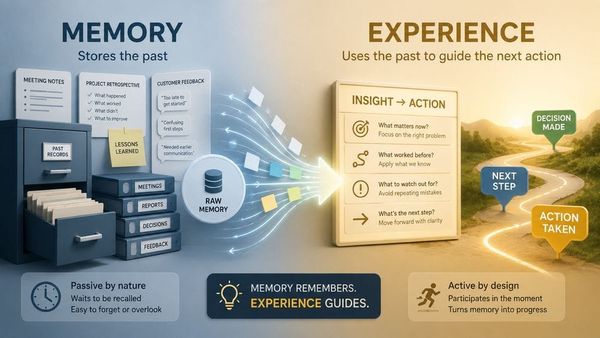
Memory preserves episodes. In the Experience Capitalization lens, repeated episodes can contribute to models that influence future recognition and action. Memory Preserves the Past A person can remember a customer case, a mistake, a difficult negotiation, or a system failure. An organization can preserve similar records in databases, documents, logs,
17 Jul 2026 1 min read
Reusable Experience
Concepts

Reusable Experience

Reusable Experience is the asset form produced through Experience Capitalization: a released model reconstructed from accumulated experience and relevant documentary or formal sources, with explicit structure, defined scope, source basis, and verification status that allow it to guide more than one future case. The Reusable Unit A memory of one
17 Jul 2026 1 min read
From Descriptive Models to Operational Models
Experience

From Descriptive Models to Operational Models

A large share of civilization's relevant model content is available through descriptive representations, model fragments, formal constraints, and documentary evidence rather than as one explicit operational model. The next step is to reconstruct that operational structure. Description Requires Interpretation A standard may state what is required. A manual
10 Jul 2026 1 min read
Automation and Experience
Ideas

Automation and Experience

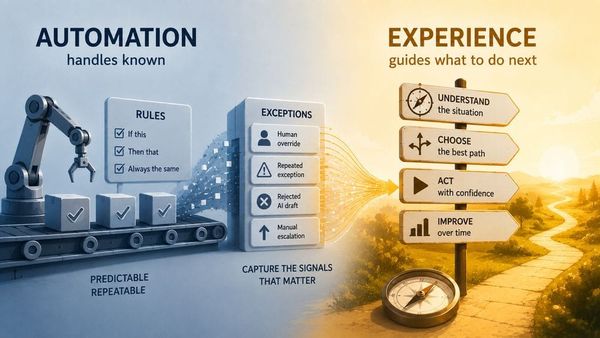
Automation applies an explicit model through an execution mechanism. Experience Capitalization addresses where that model comes from and how it becomes reusable. Automation Embodies a Model A nontrivial workflow, program, rule engine, or automated decision system embodies assumptions about entities, states, inputs, conditions, allowed actions, and results. Even when nobody

10 Jul 2026 1 min read
AI Agents and Experience
Ideas

AI Agents and Experience

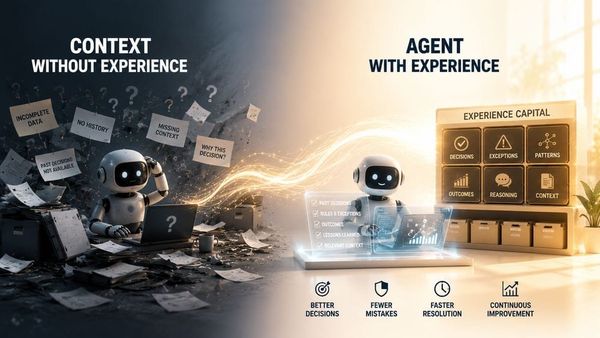
AI agents make the distinction between general intelligence and explicit operational models especially important. General Capability Is Broad An advanced AI model may encode broad learned statistical patterns about a domain and can also work with supplied documentary sources. It can read instructions, infer likely steps, generate plans, and adapt
10 Jul 2026 1 min read
The Human Glue Holding Automation Together
Experience

The Human Glue Holding Automation Together

Many organizations appear highly automated because many individual operations are already performed by software. Orders are stored in one system. Payments are processed in another. Policies are written in documents. Inventory is tracked somewhere else. Customer requests arrive through email, chat, or support software. APIs expose actions that can be
03 Jul 2026 4 min read
Work Explanation
Stack

Work Explanation

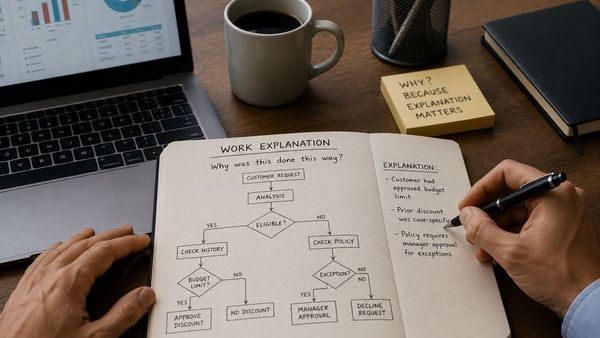
Work Explanation is an explicit representation of the model that explains why a process behaves as it does. More Than Procedure A procedure can list steps without representing the conditions that make those steps valid. A good work explanation identifies the underlying structure: entities, states, relevant facts, rules, conditions, actions,
03 Jul 2026 1 min read
Experience Architecture
Stack

Experience Architecture

Experience Architecture is the production and lifecycle system that reconstructs explicit candidate operational models from accumulated experience, observational evidence, and documentary or formal sources, then carries qualified models through verification, release, reuse, and maintenance. Source and Reconstruction Layer The architecture distinguishes production inputs from the mechanism used to process them.
03 Jul 2026 2 min read
Experience Refinery
System

Experience Refinery

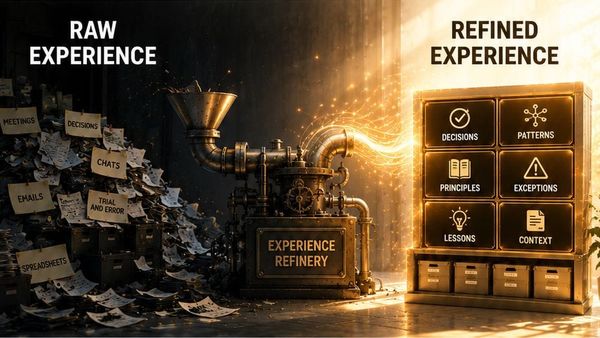
An Experience Refinery is a production mechanism that reconstructs explicit candidate models from documentary descriptions, formal sources, observational evidence, and other source material relevant to the declared scope, then carries qualified candidates through verification and release. The Input The refinery separates production inputs from the reconstruction mechanism. Targeted documentary and
26 Jun 2026 2 min read
Experience Language
Concepts

Experience Language

Experience Language is the conceptual vocabulary used to represent models reconstructed from accumulated human experience together with relevant documentary and formal sources, including governing sources where applicable. Why Language Matters Natural language is flexible enough to describe almost anything, but that flexibility leaves important relationships implicit. The same condition can
26 Jun 2026 1 min read
Experience Verification
System

Experience Verification

Experience Verification determines whether a candidate model is sufficiently supported, coherent, and bounded to be released for future use within its declared scope. Why Verification Is Necessary Human internal models can be incomplete or biased. Written sources can conflict. LLM-generated structures can be plausible but wrong. Reuse magnifies both
26 Jun 2026 2 min read
← Newer Posts Page 4 of 6 Older Posts →
Experience Capitalization © 2026
  • Home
  • Glages Model Factory Project
  • Experience Capitalization Project
  • Rights and Terms of Use
  • Privacy
  • Accessibility
  • Contact
  • FAQ
  • Map
Powered by Ghost