The AI Model Race Is Missing the Model That Matters

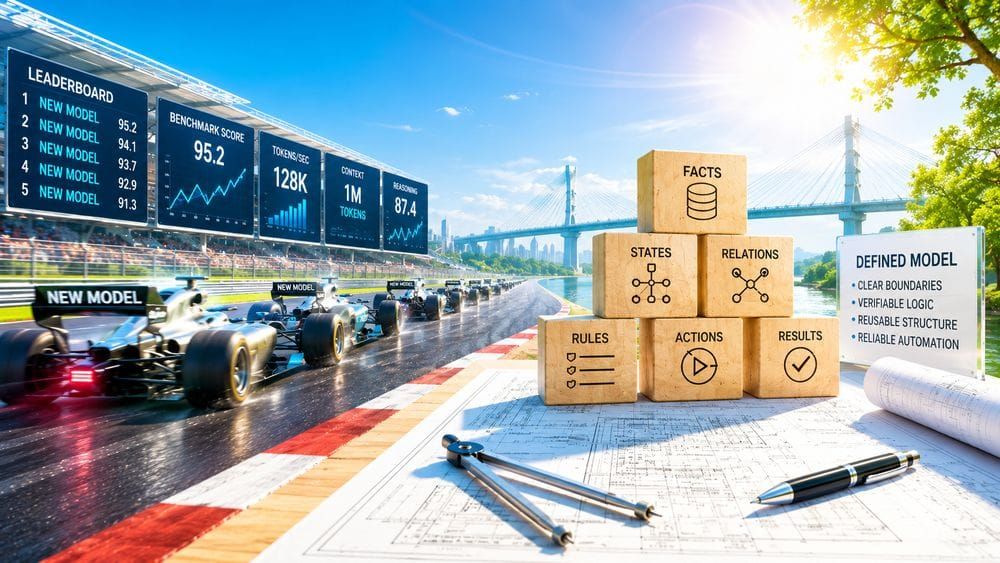
A new frontier model arrives.
It is better at coding, reasoning, tool use, mathematics, long context, or agentic tasks. A leaderboard changes. Developers run the same prompts through the new model. Social media fills with comparisons. For several days, the industry debates whether the new release is a breakthrough, a marginal improvement, or merely better benchmark optimization.
Then another model arrives.
The differences are real. Models continue to improve. Some become cheaper, faster, more capable, or easier to operate.
But the competition is becoming less useful as a guide to what organizations should actually build.
The central question is no longer:
Which language model is best?
The more important question is:
What part of the system should a language model be responsible for at all?
That question changes the meaning of the entire model race.
The Frontier Is Becoming Difficult to Measure
Comparing language models once appeared straightforward.
Give each model the same benchmark. Measure the answers. Rank the scores.
That approach is now under pressure from several directions.
Public benchmark material can enter training data. Similar tasks may be reconstructed from related material. Scores can change with prompt format, tool access, repeated attempts, context management, reasoning budget, and the amount of computation allowed during inference.
The number reported as “model performance” increasingly reflects a complete evaluation setup:
Model
+ prompt
+ context
+ tools
+ inference budget
+ retries
+ evaluator
= score
Evaluation remains useful, but its meaning has changed.
The score now reflects the full evaluation setup as much as the model itself.
Two models may trade places when the token budget changes.
A weaker model may outperform a stronger one when paired with a better harness.
A model may excel on a public benchmark while failing on a structurally similar task expressed in an unfamiliar way.
A new release may be genuinely better without being meaningfully better for the activity an organization wants to automate.
The frontier is not standing still.
But it is becoming harder to say what the distance between two frontier models actually means.
Statistical Models Are Doing What They Were Built to Do
This confusion partly comes from an impossible expectation.
A large language model is trained to learn statistical structure from enormous amounts of human-produced material.
That is its strength.
It can recognize patterns across domains, reconstruct likely meanings, continue incomplete structures, compare examples, generate alternatives, and respond to situations that were never explicitly programmed.
A statistical model captures patterns across many descriptions of reality. Authority for a specific activity requires a separate, explicit model.
The world contains incompatible practices, contradictory descriptions, local conventions, errors, obsolete instructions, cultural differences, informal workarounds, and multiple ways of interpreting the same words.
The training corpus contains all of them.
A model capable of reflecting the variety of human language must preserve uncertainty and competing possibilities.
A representation of every relevant fact, state, relationship, and permitted action would be a deterministic model of the world, a different kind of system.
Probability gives LLMs their range. Explicit operational models give automation its boundaries.
Better Average Behavior Is Not Defined Behavior
Suppose a new model chooses the correct refund action in 94 percent of test cases while the previous version succeeds in 91 percent.
That improvement may be valuable.
The improvement still leaves several operational questions open:
- Which facts are required before any refund can be considered?
- Which payment state is authoritative?
- What relationship must connect the requester, order, and payment?
- Which prior result makes another refund invalid?
- What happens when the order reference is unresolved?
- Which negative outcomes are valid business results?
- Which failures mean the activity was not executed at all?
The model may infer good answers more often.
The activity becomes defined when those answers exist independently of the inference.
A higher success rate improves behavior. A formal model creates the boundary.
It improves behavior inside an environment whose meaning may still be reconstructed during every run.
Automation requires more than a collection of likely correct answers.
Automation requires an explicit relationship between:
- the current state;
- the available facts;
- the action under consideration;
- the conditions that permit it;
- the result that may follow;
- the evidence that explains what happened.
A model can become better at guessing that relationship.
The relationship still needs to exist outside the guess.
The Impossible Goal of the Universal World Model
The current model race often carries an unstated hope.
Perhaps one more generation will know enough, reason well enough, and use tools reliably enough that detailed modeling will no longer be necessary.
The model will simply understand the organization.
But what would that require?
It would need to know which of several conflicting policies is current.
It would need to know which database field is authoritative despite misleading names.
It would need to distinguish a legitimate local rule from a historical workaround.
It would need to know which employee action exists because the activity requires it and which exists because two systems were never integrated.
It would need to know which facts are missing, which assumptions are forbidden, and where the organization’s authority ends.
Statistical regularity alone provides no reliable authority for these facts.
In many organizations, these facts remain scattered, implicit, or unresolved.
The model is being asked more than to understand the world.
It is being asked to repair the absence of a model of the world while acting inside it.
A larger corpus, a stronger reasoning score, and a longer context window all improve capability. None of them supplies the missing operational definition.
The missing structure is missing.
Every New Model Reopens the Same Question
When an organization builds directly around a particular language model, every model upgrade creates a new validation problem.
The new model may interpret instructions differently.
It may call tools in a different order.
It may be more willing to infer missing information.
It may produce a different result under the same ambiguity.
It may improve average performance while introducing a new failure mode in a critical case.
The organization must test the entire behavior again.
This is often treated as a normal cost of progress.
But it reveals an architectural dependency.
If changing the probabilistic mechanism changes the meaning of the activity, then the meaning was never represented independently.
The model was more than performing the work.
It was defining the work.
That is too much authority for a replaceable statistical component.
The Missing Layer
LLM improvement remains valuable. A reliable system assigns the LLM a bounded role.
A reliable architecture requires two different kinds of model.
The first is probabilistic.
It handles language, ambiguity, recognition, comparison, generation, and situations where several interpretations may be plausible.
The second is deterministic.
It defines the specific world in which an action may occur:
- what objects exist;
- what facts are required;
- which sources are authoritative;
- which states matter;
- which relationships must hold;
- which actions are available;
- which conditions allow or block them;
- which results are valid;
- which situations remain unresolved;
- which boundaries must not be crossed.
The probabilistic model may propose.
The deterministic model determines what the proposal means and whether it belongs to the activity.
This approach allows more flexibility than a hard-coded workflow.
A workflow describes a sequence.
A deterministic model describes the world, conditions, actions, results, and limits within which many sequences may be possible.
The LLM can remain flexible inside that world.
The surrounding model preserves the meaning of the world while the LLM acts.
Determinism as an Operational Boundary
The word “deterministic” often creates the wrong impression.
It sounds as though every step must be predetermined and every situation reduced to a rigid decision tree.
The requirement is an explicit boundary of valid operation.
Inside that boundary, an LLM may:
- interpret a message;
- extract candidate facts;
- compare bounded alternatives;
- draft a response;
- summarize evidence;
- propose a new relationship;
- generate a candidate plan;
- recognize that existing models do not cover the case.
The wording may remain open while the effects it can cause remain defined.
Many routes through the activity may remain possible inside defined states, actions, and results.
The mechanism may remain probabilistic.
The operational meaning remains stable.
A Better Basis for Comparison
Once this layer exists, the model race becomes less important.
One LLM may be better at extracting facts from unstructured documents.
Another may be better at coding.
Another may be cheaper for classification.
Another may be stronger at proposing candidate models.
Those differences remain useful.
But they become differences among replaceable mechanisms operating inside a stable activity.
The organization can replace a broad question with a narrower one:
Can this model be trusted to understand our entire business correctly?
It can ask narrower questions:
- Which model performs this bounded interpretation most accurately?
- Which model produces the best candidates at an acceptable cost?
- Which model works best with this type of evidence?
- Can a cheaper model perform this step without changing the operational result?
- Can the mechanism be replaced without redefining the activity?
That is a far more mature form of model comparison.
The useful benchmark measures how well a mechanism performs a defined function inside a verified system.
Why This Also Changes Economics
The current race encourages organizations to keep purchasing intelligence by the token.
Every execution may include policies, examples, tool descriptions, business terminology, historical context, and reminders about what must not happen.
The LLM reconstructs a temporary version of the activity inside its context.
Then that context is consumed.
The next request begins again.
A deterministic model changes the economics because stable meaning no longer has to be repeatedly narrated to the probabilistic mechanism.
Context is consumed. A model is reused.
The LLM still receives the information needed for its bounded task.
Its input can stay focused on the bounded task instead of repeating the organization’s entire operating explanation.
This reduces more than token consumption.
It reduces the number of meanings that can drift when models, prompts, context strategies, or vendors change.
The End of the Model Race
The LLM race will continue.
Models will continue to improve.
There will be better reasoning, longer context, lower prices, stronger multimodality, more effective tool use, and new forms of training and inference.
But for practical automation, the race may already be reaching the limit of its importance.
The next frontier model may be meaningfully better than the current one.
The meaning of the activity still comes from an explicit operational model.
That meaning has to be modeled.
The decisive architecture of the next phase will combine two complementary kinds of model.
It will combine:
A probabilistic model
for interpreting what is uncertain

with

A deterministic model
for defining what must be true
The first gives the system reach.
The second gives it boundaries.
The first can generate possibilities.
The second makes reliable action possible.
The future of AI automation depends less on a universal winner and more on a clear division of responsibility.
Language models belong where statistical flexibility is an advantage. Deterministic models belong where the meaning of reality must remain stable.