The Missing Link Between Models and Automation

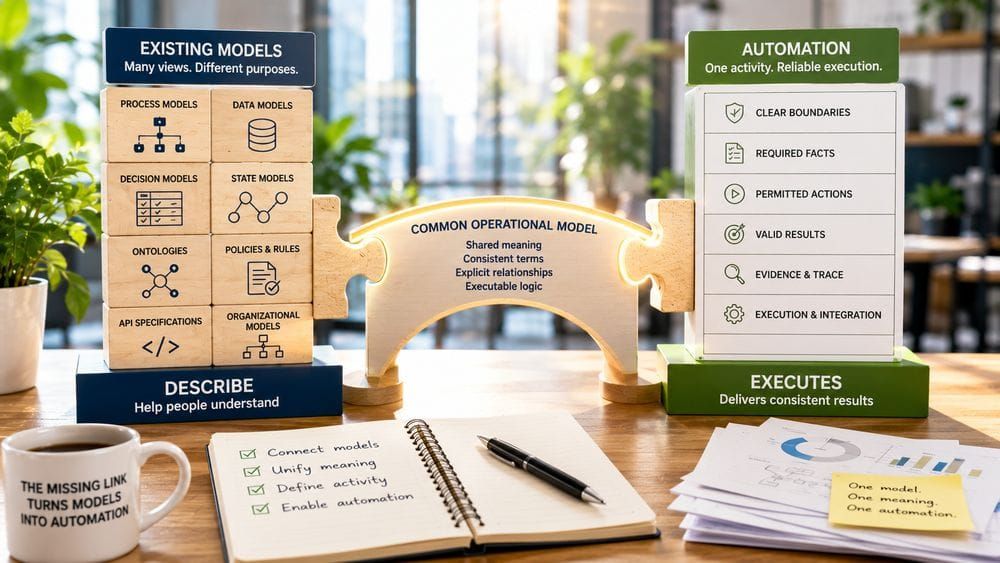
Modeling has existed for a long time.
Organizations use process diagrams, data models, decision tables, state machines, ontologies, enterprise architecture, formal specifications, workflow systems, and software models.
Entire professions have grown around them.
Business analysts model processes. Architects model systems. Engineers model structures and behavior. Developers model domains in software. Data teams model information. Operations teams document procedures. Compliance teams express rules and constraints.
The modern organization already contains many models.
The difficulty appears when those models are expected to become automation.
Each one describes a part of the activity. The activity itself remains distributed across diagrams, databases, policies, software, integrations, and human interpretation.
The models exist.
The missing link is a common model that can carry their meaning into execution.
Many Models, Many Purposes
Existing modeling methods were created to solve different problems.
A process model shows a sequence of work.
A data model defines records, fields, and relationships.
A state machine describes possible states and transitions.
A decision table connects conditions to choices.
An ontology organizes concepts and semantic relationships.
An API specification defines available operations and their technical inputs.
An organizational chart describes roles and reporting relationships.
A policy document states rules, obligations, and restrictions.
Software expresses one implemented version of the activity.
Each representation can be valuable.
Each one also sees the activity from a particular direction.
A process diagram may contain a step called Approve Order.
The data model may contain a field called Approved.
The policy may describe who can authorize an exception.
The API may expose an operation called approveOrder.
The application may set the field after a user clicks a button.
These elements appear to describe the same thing.
Their names create a sense of unity.
The structure may still leave several questions open:
- Which facts make approval valid?
- Which state allows the action?
- Which role carries the required authority?
- Which order does the decision refer to?
- Which result is created?
- Which later actions depend on that result?
- What happens when the required facts are missing?
The process, data, policy, API, and software models may each be internally correct while answering different parts of the question.
The activity between them remains implicit.
Models Were Designed as Views
Most modeling languages provide a view of a system.
A process diagram gives a process view.
A class diagram gives a structural view.
A state machine gives a behavioral view.
A decision model gives a rule view.
An ontology gives a conceptual view.
An enterprise architecture model gives an organizational and technical view.
Views are useful because complex systems cannot be understood from one angle alone.
They help people reason about particular concerns without carrying the full complexity of the activity at once.
The difficulty begins when separate views use familiar words as though shared vocabulary guaranteed shared meaning.
The same word may refer to different things in different models.
A process status may describe where work appears in a workflow.
A database status may record the last operation performed.
A business state may describe what is currently true in the world.
These three statuses can have the same name and different meanings.
Human readers often reconcile them automatically. They know which diagram is simplified, which field is unreliable, which exception applies, and which system has authority.
Execution requires those relationships to be explicit.
A collection of views becomes automation only when they share a common operational meaning.
Models Often Depend on the Reader
Traditional models were usually created to support communication among people.
An analyst explained a process to a developer.
An architect explained a system to a team.
A manager explained a policy to employees.
An engineer explained a design to reviewers.
The model did not need to carry every part of its own meaning. The reader supplied context, background knowledge, and reasonable interpretation.
A box labeled Verify Payment can work well in a process diagram.
A person understands that verification probably involves checking a payment record, its state, its amount, and its relationship to an order.
A reliable automation needs those assumptions represented directly.
It needs to know:
- which payment record is relevant;
- which source is authoritative;
- which state counts as completed;
- which amount is being compared;
- which relationship connects the payment to the order;
- which result follows from successful verification;
- which cases remain unresolved.
This is the distinction between a representation that helps a person understand and a model that can govern execution.
The question is whether the meaning is carried by the structure or supplied by the reader.
A model prepared for execution must carry more of its meaning inside itself.
Description and Execution Developed Separately
For most of the history of business automation, models and programs lived in separate worlds.
The business side described the activity.
Analysts translated the description into requirements.
Architects translated the requirements into technical structures.
Developers translated those structures into software.
Employees interpreted the software during daily operation.
The chain often looked like this:
Business description
        ↓
Analyst interpretation
        ↓
Technical specification
        ↓
Developer interpretation
        ↓
Software implementation
        ↓
Employee interpretation during operation
This arrangement could work because people remained inside every transition.
They filled gaps between business language and technical structures.
They recognized when software behavior diverged from the actual situation.
They knew when a field name was misleading.
They resolved cases that fell between formal rules.
The result was human-machine automation.
Software executed the parts that had been made explicit. People preserved the meaning between them.
Modern AI appears capable of taking over some of this interpretation. It can read documents, compare records, interpret messages, and choose tools.
That capability makes the missing common model more visible.
The AI receives the same fragmented descriptions that people previously reconciled. It then reconstructs the activity during execution, with different results depending on context, prompting, examples, and the model being used.
The historical separation between description and execution has become an architectural problem.
Executable Models Already Exist
The idea of executable modeling is also well established.
Workflow systems execute process sequences.
Rules engines evaluate conditions.
State machines control transitions.
Low-code platforms generate applications.
Model-driven development produces software structures from higher-level representations.
Simulation systems execute models of physical, financial, or operational behavior.
These approaches proved that models can drive execution.
They also reveal the remaining gap.
Usually, one part of the activity becomes executable.
A workflow engine executes the sequence.
A rules engine evaluates selected conditions.
A state machine controls predefined transitions.
A data model constrains stored records.
An API schema validates technical inputs.
The rest of the meaning remains elsewhere.
The workflow may know which step follows Approve Order while relying on another system to define approval.
The rules engine may evaluate customerEligible == true while relying on software or human judgment to establish eligibility.
The API may validate the shape of a refund request while leaving the business validity of the refund unresolved.
Execution exists, but it is divided among models that lack a single shared definition of the activity.
The Missing Unit Is the Activity
A large part of the problem comes from the unit being modeled.
Organizations model systems, applications, databases, departments, roles, workflows, documents, and interfaces.
Automation needs a model of the activity itself.
A refund is an activity.
An approval is an activity.
A shipment is an activity.
A hiring decision is an activity.
Each activity connects several kinds of meaning:
- the things involved;
- the facts that must be known;
- the states that matter;
- the relationships that must hold;
- the conditions that permit action;
- the authority behind a decision;
- the actions that may occur;
- the changes those actions produce;
- the valid results;
- the cases that remain unresolved;
- the evidence retained after execution.
Today these elements are often scattered across separate artifacts.
The process model contains the steps.
The data model contains records.
The policy contains conditions.
The organization chart contains roles.
The API contains operations.
The application contains implemented behavior.
The logs contain what actually happened.
A model of the activity brings these elements into one operational structure.
It does not replace every existing representation.
It gives them a shared source of meaning.
A Model for Automation Has a Different Responsibility
A model designed for automation must do more than explain one aspect of the system.
It must define enough of the activity to govern execution.
That responsibility creates a practical standard.
The model should identify what its terms refer to.
Its states should resolve to observable facts.
Its relationships should remain explicit.
Its actions should have defined conditions.
Its results should be distinguishable from technical operations.
Its unresolved cases should remain visible.
Its boundaries should survive changes in software, workflows, agents, and vendors.
Its meaning should remain stable when familiar names are replaced with neutral identifiers.
These requirements lead to two useful tests.
The Referent Test asks whether each meaningful term resolves to something observable or traceable.
The Renaming Test asks whether the model preserves its conditions, relationships, actions, and results after familiar labels are replaced with neutral identifiers.
Together, they expose models whose apparent precision comes mainly from persuasive terminology.
A field called Approved carries little authority by itself.
A structure that connects evidence, authority, conditions, action, and result carries operational meaning.
Existing Models Become Sources
The move toward an automation model does not discard previous forms of modeling.
It changes their role.
A process diagram can provide candidate actions, ordering constraints, and handoffs.
A data model can provide candidate things, properties, references, and relationships.
A state machine can provide candidate states and transitions.
A decision table can provide candidate conditions and results.
An ontology can provide terminology and semantic relations.
A policy can provide obligations, permissions, and restrictions.
An API specification can provide available technical operations.
Software can reveal the behavior actually implemented.
Logs can reveal the behavior actually executed.
Each source contributes evidence.
The automation model brings that evidence into a common structure and checks where the sources agree, where they describe different layers, and where they contradict one another.
This makes existing models more useful.
Their contents become connected to the activity they describe rather than remaining isolated representations maintained by separate teams.
The Company Is One Connection, Not the Standard
A common activity model should also remain separate from one company's current arrangement.
Every organization has local systems, policies, thresholds, authorities, contracts, and operational constraints.
These details matter.
They belong in the connection between the activity model and the organization.
The company identifies:
- which records represent the relevant things;
- which fields correspond to required states;
- which systems provide authoritative facts;
- which operations perform valid actions;
- which roles carry authority;
- which local parameters narrow the activity;
- which required capabilities are missing.
This separation prevents current practice from becoming the definition of the activity.
A manual workaround may reveal a missing integration.
A duplicated check may reveal unreliable data.
An unusual responsibility may reflect an accidental staffing arrangement.
A local restriction may be a legitimate business constraint.
The model provides a stable reference for distinguishing among them.
The organization connects to the activity.
The activity is not reconstructed from the organization's accumulated disorder.
Why a Common Model Was Difficult Before
A unified model of activity sounds obvious once described.
Historically, it was expensive to build and maintain.
The relevant information was spread across documents, software, databases, diagrams, conversations, and employee experience.
Different teams used different vocabularies.
Comparing models required extensive manual analysis.
Corrections in one representation rarely propagated to the others.
Natural language contained much of the meaning, and converting it into precise structures required scarce expertise.
People therefore remained the practical integration layer.
They carried context from one model to another and repaired inconsistencies during operation.
This arrangement supported partial automation at a manageable cost.
It also limited how far automation could proceed.
AI Changes the Economics of Modeling
Modern AI changes the cost of working with fragmented source material.
It can read large collections of documents.
It can identify recurring concepts.
It can compare descriptions.
It can extract candidate facts, states, conditions, actions, and results.
It can find inconsistencies across policies, software, and process descriptions.
It can propose candidate connections among existing models.
This makes large-scale model construction economically possible.
Formal structure gives those candidates a path to verification.
AI can help recognize and propose.
The model system can test referents, preserve semantic relationships, enforce boundaries, and distinguish stable meaning from plausible language.
The combination matters.
AI alone produces interpretations.
Formal models alone are expensive to construct from fragmented human material.
Together, they create a practical path from accumulated descriptions to verifiable automation models.
From Modeling Artifacts to Experiential Capital
Once models of activity become reusable, they also become a form of Experiential Capital.
A corrected refund condition can improve every later implementation of the refund model.
A newly identified relationship can become available across organizations.
A failure in one connection can reveal a missing distinction in the common model.
A verified activity model can reduce the cost of the next automation project.
Existing modeling artifacts often remain local to one project, team, or system.
A common activity model allows what was learned to accumulate.
The process becomes:
Existing models and evidence
        ↓
Common activity model
        ↓
Connection to an organization
        ↓
Controlled execution
        ↓
New experience
        ↓
Correction of the model
The result of one implementation strengthens the starting point for the next.
That is the commercial and operational value of moving from separate modeling artifacts to a reusable model system.
The Next Step After Modeling
The history of modeling has produced many valuable ways to represent work.
Process models show flow.
Data models show structure.
State machines show change.
Decision models show conditions.
Ontologies show concepts.
Software shows implementation.
Each one contributes part of the picture.
The next step is to connect those parts through a model of the activity itself.
That model carries meaning across analysis, implementation, execution, and verification.
It gives existing representations a shared reference.
It allows different execution mechanisms to participate in the same defined activity.
It preserves what organizations learn as models are tested and corrected.
Modeling has already given us the necessary views.
Automation begins when those views share one operational model of the activity they describe.