Three Domains of Experience Capitalization

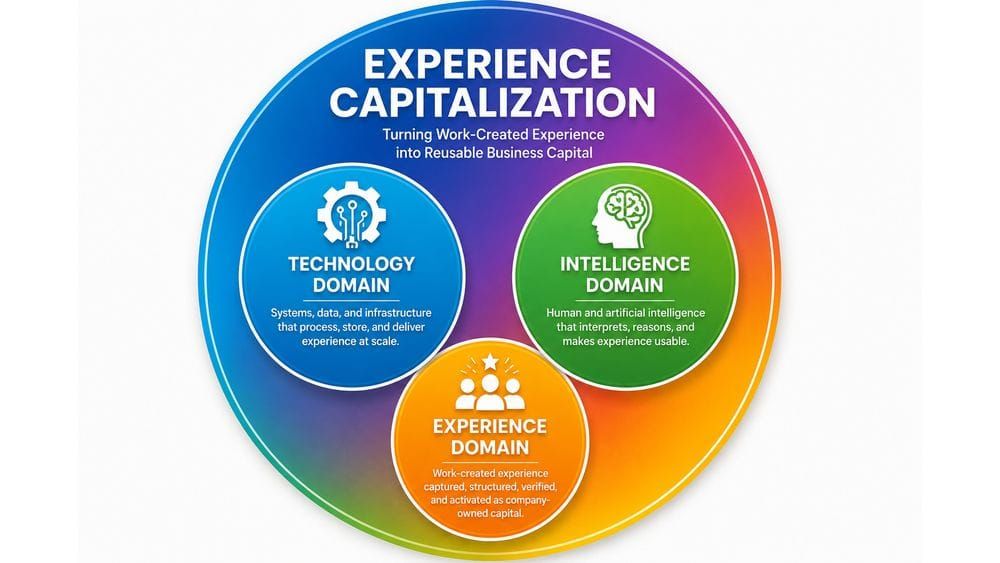
Three Domains of Experience Capitalization

Experience Capitalization is a business function built around three domains: Experience, Intelligence, and Technology.

Experience is the material. Intelligence works on the material. Technology makes the work operational. Experience Capitalization organizes all three around one goal: turning work-created experience into reusable company-owned capital.

This distinction matters because companies often treat tools, AI methods, records, memory, and experience as if they were the same thing. They are connected, but they do different work. A company can use advanced technology without preserving experience. It can use AI without becoming more experienced. It can keep records without turning the lessons inside those records into capital.

Experience Capitalization begins when these domains are organized around a clear business function: capture what real work teaches, make it trustworthy, bring it back into future work, and measure whether it improves action.

                    EXPERIENCE CAPITALIZATION
         ________________________________________________
        /                                                \
       /                                                  \
      |    Experience      Intelligence      Technology    |
      |     Domain           Domain           Domain       |
      |                                                    |
       \                                                  /
        \________________________________________________/

The domains are not competing descriptions of the same thing. They are three planes of the category.

The Experience Domain explains what is being capitalized.

The Intelligence Domain explains how the material is interpreted, judged, verified, and applied.

The Technology Domain explains how the work becomes operational inside real systems.

Experience Domain

The Experience Domain defines the material itself.

It answers a practical question: what is work-created experience, how is it structured, and what properties must it have before it can become capital?

This domain includes the concepts that make experience usable instead of vague. A company cannot capitalize experience if experience remains only a memory, a note, a chat transcript, a ticket, or a general impression. It needs forms that can be examined, trusted, connected, updated, and reused.

An Experience Signal is the moment inside real work where a reusable lesson may be present: a correction, rejection, exception, human override, failed attempt, or repeated pattern.

An Experience Object is the structured unit of reusable experience: a lesson, warning, correction, local rule, rejected path, decision reason, or tested pattern.

Experience Evidence connects an Experience Object to the work that produced it. Without evidence, experience becomes organizational rumor.

Experience Lineage shows where experience came from, how it changed, where it was reused, and whether it still deserves trust.

Experience Scope defines where experience applies and where it should stay quiet.

Experience Lifecycle keeps experience current as it moves from candidate to verified, active, challenged, deprecated, or retired.

Experience Conflict appears when two lessons point in different directions and need conditions, authority, or review.

Experience Authority determines how much power experience should have over future work: suggestion, warning, required check, AI context, workflow control, or rule.

These are not implementation details. They describe the material that Experience Capitalization works with. Technology may store them. Intelligence may interpret them. The Experience Domain defines what they are.

Intelligence Domain

The Intelligence Domain describes the cognitive work required to turn raw work traces into usable experience.

It answers a practical question: which kind of intelligence should handle each job?

A serious Experience Capitalization system cannot depend on one form of intelligence for everything. Real work produces language, exceptions, judgments, patterns, rules, conflicts, evidence, and risks. Different parts of that work require different kinds of intelligence.

Human intelligence provides judgment, responsibility, authority, and business meaning. People decide whether a lesson deserves trust, whether scope is correct, whether risk requires stronger control, and whether experience should be allowed to affect future work.

Generative intelligence works with language. It reads tickets, AI traces, support conversations, code reviews, approvals, and work explanations. It can identify possible Experience Signals and draft candidate Experience Objects for review.

Symbolic intelligence gives experience structure. It expresses rules, conditions, exceptions, relations, scope, authority, and conflicts in forms that can be checked and activated.

Neuro-symbolic intelligence connects neural interpretation with symbolic structure. It is useful when messy work language needs to become a scoped rule, condition, exception, or conflict.

Statistical and machine-learning intelligence helps with ranking, similarity, clustering, scoring, and pattern detection. It can find related cases, repeated signals, and situations that resemble what the organization has already learned.

Deterministic intelligence handles exact operations. It checks permissions, applies thresholds, evaluates defined conditions, and triggers actions where the rules are clear.

Verification intelligence protects the system from turning weak learning into operational power. It checks evidence, scope, conflict, lifecycle status, authority, and consistency before experience guides future work.

The Intelligence Domain is about forms of reasoning, judgment, interpretation, and verification. It is not a list of tools. An LLM as a deployed model belongs to Technology. Generative intelligence as a capability belongs to Intelligence. The same term may appear in different discussions, but its role changes by domain.

Technology Domain

The Technology Domain describes the machinery that makes Experience Capitalization operational.

It answers a practical question: what technical components let the system detect, structure, preserve, verify, activate, and measure experience inside real work?

Technology does not define Experience Capitalization. It makes the business function possible at useful speed and scale.

LLMs help read messy work traces and propose candidate lessons from conversations, tickets, code changes, agent logs, and work explanations.

RAG and retrieval systems help find relevant stored material, prior cases, documents, notes, or evidence. Retrieval can support Experience Capitalization, but retrieval is only one technical function.

Vector databases support semantic similarity. They help find related experience when the current situation uses different words from earlier cases.

Graph databases support lineage and relationships. They can connect an Experience Object to evidence, customer segment, workflow state, business object, owner, conflict, reuse history, and later updates.

Rules engines support activation when verified experience should trigger a warning, required check, AI instruction, workflow route, or automation constraint.

Relational databases hold governed records such as ownership, lifecycle status, authority level, approval history, activation history, and permissions.

Document stores preserve the source material behind experience: tickets, transcripts, approvals, code reviews, work explanations, customer cases, and evidence.

Workflow engines move experience through review, verification, activation, challenge, update, deprecation, and retirement.

Event logs and audit trails record what happened to experience after capture: who changed it, where it activated, whether it was accepted, and whether it produced value.

Verification tools help test whether experience remains sound, current, scoped, and connected to its evidence.

APIs and integrations connect Experience Capitalization to the systems where work happens: CRM, ERP, support platforms, code repositories, AI-agent workflows, document systems, communication tools, and analytics.

User interfaces make human judgment practical. People need to review, approve, correct, challenge, downgrade, retire, and govern experience without turning the system into bureaucracy.

The Technology Domain is important because Experience Capitalization cannot operate by intention alone. The company needs machinery. But the machinery is not the category. It serves the category.

Why the Domains Matter

The three domains prevent category collapse.

A tool is not the category. A model is not the category. A database is not the category. A reasoning method is not the category. A stored record is not the category.

RAG belongs to the Technology Domain. It can help retrieve material, but it does not define Experience Capitalization.

Generative AI belongs to the Intelligence Domain as a capability and to the Technology Domain when implemented as a model. It can help extract and draft, but it does not define Experience Capitalization.

Neuro-symbolic AI belongs to the Intelligence Domain as an approach for combining interpretation and structure. It can be powerful inside Experience Capitalization, but it is not the business function.

Knowledge management belongs to the neighboring world of explicit knowledge. It may support Experience Capitalization, but it does not define the Experience Domain and does not perform the capitalization function.

Organizational learning describes improvement over time. Experience Capitalization is more operational: it defines the material, the intelligence used to work with it, the technology that supports it, and the business function that turns it into capital.

This is the clean category boundary. The components may be useful. Some may be necessary. None of them is the whole category.

The Organizing Function

Experience Capitalization is not another domain next to Experience, Intelligence, and Technology.

It is the organizing business function.

The Experience Domain provides the material: work-created practical experience with evidence, lineage, scope, lifecycle, conflict, and authority.

The Intelligence Domain provides the cognitive work: interpretation, judgment, structure, verification, ranking, reasoning, and application.

The Technology Domain provides the operational machinery: the systems, databases, engines, workflows, logs, interfaces, and integrations that let experience move through real work.

Experience Capitalization gives all three domains direction. It decides what should be preserved from work, how that material becomes trustworthy, how it gains authority, when it returns to future work, and how its value is measured.

Without the organizing function, the domains remain separate capabilities. Technology remains infrastructure. Intelligence remains processing. Experience remains memory.

Experience Capitalization turns them into capital.

The Practical Test

Any component in this space can be located by asking four questions.

Is this a tool, database, engine, interface, API, integration, storage method, or workflow component? Then it belongs to the Technology Domain.

Is this a form of reasoning, interpretation, judgment, scoring, verification, or decision-making? Then it belongs to the Intelligence Domain.

Is this a property, unit, structure, boundary, evidence base, lifecycle state, or authority condition of experience itself? Then it belongs to the Experience Domain.

Is this the business function that turns work-created experience into owned, governed, activated, measured capital? Then it is Experience Capitalization.

That test keeps the category clear without making the argument defensive.

Experience is the material. Intelligence works on it. Technology makes the work operational. Experience Capitalization turns the result into capital.

The domains explain the system. The business function defines the category.