Glages: What the Model Factory Produces

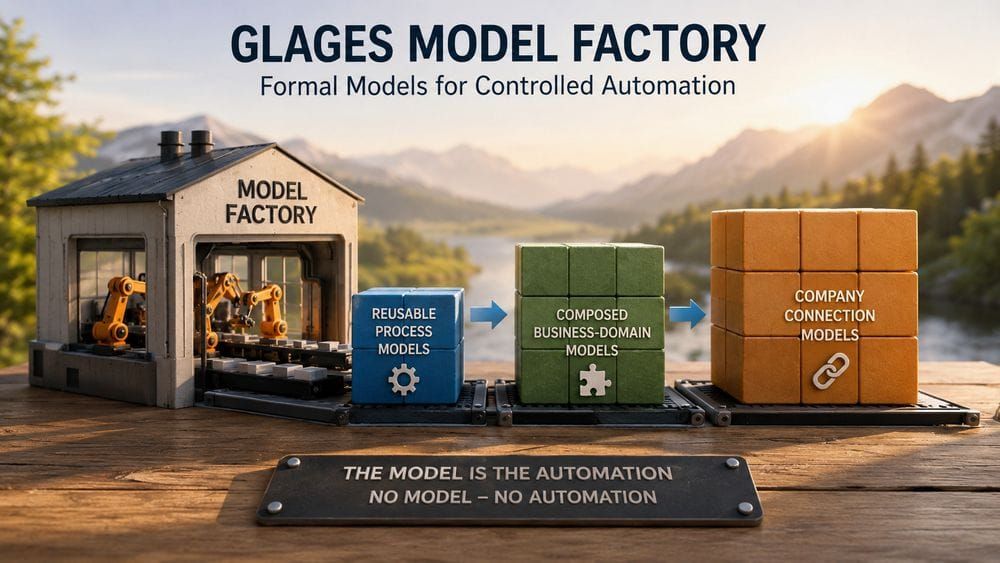
A factory is defined by what comes out of it.
Glages is a formal-model production technology for creating explicit, machine-checkable Glages Models from generalized domain knowledge.
The Glages Model Factory Project develops the production system required to create, verify, release, reuse, compose, specialize, and maintain those models systematically.
The primary product is the released, reusable Glages Model.
A Glages Model can represent the Entities, Processes, states, relationships, facts, conditions, actions, changes, results, and boundaries required for a defined computational purpose.
Across applications, the important model properties are formal structure, verifiability, reuse, composition, specialization, explicit stopping boundaries, and reduced dependence on runtime inference.
The Business-Domain Model Factory is one major application of Glages. It produces process and business-domain Glages Models and releases reusable model products for AI automation and software systems.
Business-Domain Application: Reusable Process Models
A process Glages Model can describe a process class that appears in many industries. After Release, it can serve as a reusable model product. Payment, refund, reservation, approval, shipment, delivery, claim handling, invoicing, repair, and document verification are examples.
The model defines the stable meaning of the process. It identifies the participating Entities, relevant states and relationships, required facts, applicable conditions, permitted actions, allowed changes, valid results, and stopping conditions.
A refund model, for example, must distinguish a refundable payment from an unrelated transaction. It must define whether the requested amount is available, whether a refund has already been completed, whether authority exists, and what results may be returned. Those questions arise in retail, hospitality, equipment rental, insurance, logistics, and many other markets.
The process remains recognizably the same even when companies use different databases, payment providers, policies, and field names. That common structure is what makes the model reusable.
Composed Business-Domain Models
A business is not one process. It is a connected system of processes whose states and results affect one another.
Within the Business-Domain Model Factory application, compatible process Glages Model assets in the Accepted or Released lifecycle state can be composed into candidate business-domain Glages Models. An e-commerce model may connect order, payment, inventory reservation, shipment, delivery, modification, return, refund, claim handling, and customer service.
The value of the composition is not the presence of several models in one package. The value lies in their defined relationships.
A payment result may determine whether an order can continue. A shipment state may determine whether an order can still be modified. Delivery begins after shipment has handed the item over for transport and then tracks movement, attempts, and final delivery results. A refund may depend on both the payment history and the state of the order.
When these relationships are modeled together, the licensee receives a coherent foundation for an entire class of business rather than a collection of disconnected automations.
Licensee Application After Release
After Release, a licensee can use a process or business-domain Glages Model inside its own software, automation, integrations, and execution environment.
The licensee maps its own data, APIs, roles, parameters, and execution mechanisms to the model through application code and the Formal Model Interface. Those implementation choices do not redefine the common Glages Model.
The General Glages Model Production Structure
At the broadest level, the factory follows this production path:
generalized domain knowledge
+ accepted or released Glages Model assets where relevant
→ candidate Glages Model
→ Program Acceptance
→ `Accepted` lifecycle state
→ Model Adequacy
→ package construction
→ candidate release package
→ package and integrity checks
→ verified release package
→ Release Eligibility
→ Release
→ `Released` lifecycle state
→ reusable Glages Model product
The output may be a broad model, a narrow model, a composed model, or a Factory-produced specialization for a defined market, task class, device class, mission class, or computational constraint.
The same production approach can support AI automation and software systems, autonomous systems, robotics, formal verification and certification, simulation, planning, software design, and edge or inference-constrained systems.
The Business-Domain Product Hierarchy
For the Business-Domain Model Factory application, the connected product hierarchy is:
base concepts and relationships
→ process Glages Model assets in the `Accepted` or `Released` lifecycle state
→ Composition
→ candidate business-domain Glages Model
→ Program Acceptance
→ `Accepted` lifecycle state
→ Model Adequacy
→ package construction
→ candidate release package
→ package and integrity checks
→ verified release package
→ Release Eligibility
→ Release
→ `Released` lifecycle state
The base layer gives models compatible meanings and relationships. Reusable process Glages Model assets define common activities. Composition creates a coherent candidate business-domain Glages Model. After Program Acceptance moves the candidate into the Accepted lifecycle state, Model Adequacy can be established for that accepted model. Package construction then produces a candidate release package; package and integrity checks produce the verified release package; a positive Release Eligibility determination permits Release; and Release moves the model into the Released lifecycle state, where it becomes a reusable product that licensees can apply in their own environments.
After Release, business-domain Glages Models are available as licensed, reusable software products. Accepted or released Glages Model assets may also serve as Model Factory inputs for later Composition and Specialization.
The Glages Model Factory therefore produces more than one business-specific hierarchy. It produces reusable Glages Models and the production capability required to create, verify, release, and maintain them systematically across different application domains.