When a Model Only Looks Precise

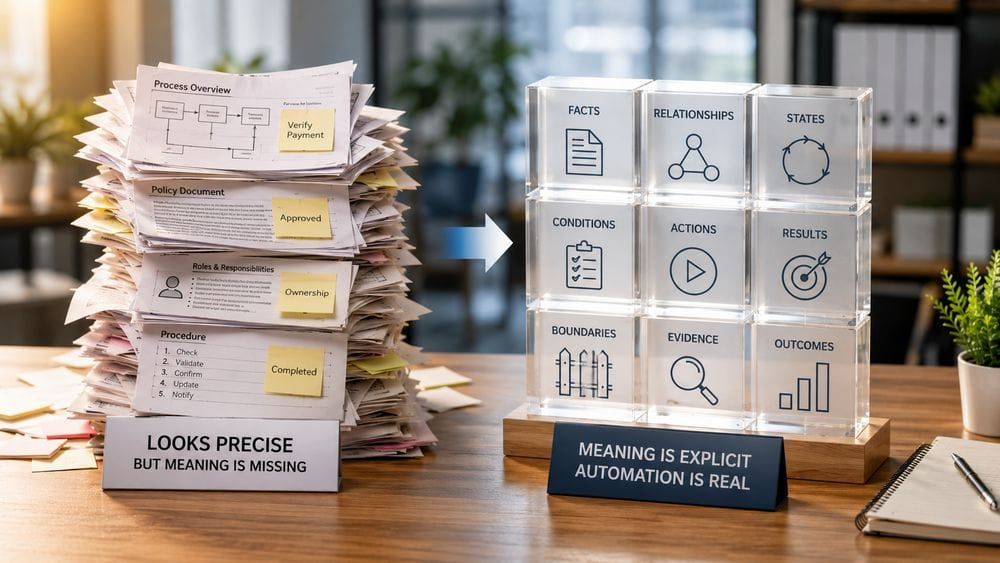
Organizations are full of documents that look precise.
Processes have names. Roles have titles. Systems have statuses. Policies contain conditions. Diagrams show arrows from one box to another. Software contains fields called Approved, Completed, Verified, and Eligible.
This creates an impression that the activity has been modeled.
Often the apparent precision lives only in the terminology.
The words are present, but the meaning still depends on a person who knows what those words are supposed to mean in this particular situation.
That distinction matters because a description can guide a person while remaining unusable as a reliable model.
A person can interpret an incomplete instruction, notice that a status is misleading, remember an exception, and avoid an action that would produce an unreasonable result.
A system cannot do this reliably unless the meaning has been represented in the model itself.
Names Can Hide the Absence of Meaning
Consider a process diagram containing a step called:
Verify the payment.
It sounds clear.
But what exactly must be verified?
- That a payment record exists?
- That the payment was authorized?
- That the money was captured?
- That the amount matches the order?
- That the payment has not already been refunded?
- That the recipient is the correct party?
- That the information comes from an authoritative source?
The phrase leaves all of these questions open.
It works only because a person supplies the missing interpretation.
The same problem appears in job descriptions:
- strong communication skills;
- ownership;
- ability to work under pressure;
- comfort with ambiguity;
- cross-functional leadership.
These expressions describe a general impression while leaving the activity, facts, conditions, actions, and results undefined.
They are containers into which different readers place different meanings.
A reliable model requires a stronger foundation.
No Physical Referent , No Meaning
A useful model must connect its terms to something that can be observed, checked, or traced.
“Payment verified” gains operational meaning when it resolves to specific facts.
“The payment record exists” is more precise.
“The payment is linked to this order” is more precise.
“The payment state is captured” is more precise.
“The captured amount is equal to the amount required by the order” is more precise.
Each statement points to something that can be examined.
This suggests a practical test:
No physical referent — no meaning.
In practice, this means that every meaningful term must resolve to an observable fact, relationship, state, event, or result.
This does not require that every model must describe the physical world in microscopic detail.
It means that the model must eventually point outside language.
A customer, payment, shipment, approval, response, decision, or change must refer to something distinguishable in the world or in a system that represents the world.
A model that stays entirely inside language becomes a collection of words explaining other words.
Document and Model
Clearer documentation helps readers. A model serves a different purpose.
A better document may be clearer, shorter, more consistent, and easier to read.
Those are useful improvements.
Even beautiful writing can leave the reader responsible for interpretation.
A model must do something more.
It must make explicit:
- what exists;
- which facts matter;
- which relationships must hold;
- which states are possible;
- what may happen;
- under which conditions an action is valid;
- what result may follow;
- what prevents execution;
- what evidence remains after the activity is complete.
The main difference lies in where the meaning resides.
A paragraph, diagram, table, database, or program can all contain either a real model or only the appearance of one.
The question is whether the meaning is carried by the structure or supplied by the reader.
The Renaming Test
There is a simple thought experiment that reveals hidden dependence on names.
Imagine replacing the familiar names in a model with neutral identifiers.
ApprovedRefund becomes R17.
EligibleCustomer becomes E04.
VerifiedPayment becomes S09.
Would the model still preserve the same relationships, conditions, permitted actions, and results?
Could someone still determine why the refund is allowed?
If the answer is yes, the meaning is probably represented structurally.
If the answer is no, the meaning was hidden in the labels.
The original name may have sounded precise, but it was performing the work of an explanation instead of identifying a formally represented state.
This test is useful because human-readable names are persuasive.
A field called Approved feels safer than a field called X12, even when neither has a defined relationship to the facts that justify approval.
The label creates confidence.
The structure creates meaning.
The Current Company Is Not the Standard
Another danger appears when organizations try to model their own activity.
The obvious approach is to observe what people currently do and record it.
Current practice often mixes the activity with historical arrangements and workarounds.
It may contain:
- duplicated checks;
- missing integrations;
- obsolete restrictions;
- informal exceptions;
- accidental responsibilities;
- local workarounds;
- actions performed only because another system is unreliable.
Copying all of this into a model preserves the current arrangement instead of revealing the logic of the activity. The result is a formal version of the current disorder.
A model of a refund should describe the logic of a refund.
A model of approval should describe what an approval requires.
A model of hiring should describe the relevant activity, facts, decisions, and results.
The company’s current practice should then be compared with the model.
Where the two correspond, the activity may be ready for reliable execution.
Where they diverge, the difference must be examined.
Some differences may reflect legitimate local conditions.
Others are defects that deserve correction.
Process, Not Position
This also explains why a job title is rarely a useful unit of modeling.
A position is often an accidental container.
One employee may perform one process or twenty. Responsibilities may have accumulated because someone left, a system changed, a department was reorganized, or a capable person became the default destination for every unresolved case.
The title may remain the same while the activity changes completely.
Trying to model “what the manager does” therefore mixes together unrelated processes, historical accidents, and compensatory work.
The meaningful unit is the process:
- what enters it;
- which facts it requires;
- what conditions matter;
- what actions occur;
- what changes;
- what result is produced.
Staffing can then be arranged around the process.
The staffing arrangement should be designed around the process.
AI and Model Construction
Generative AI is very good at interpreting familiar language.
That makes it useful for reading documents, recognizing possible concepts, comparing descriptions, and proposing candidate structures.
The same fluency can also make an incomplete model appear complete.
AI has learned from human language, including vague job descriptions, incomplete procedures, informal workarounds, and words whose meaning was always supplied by context.
It can produce a plausible interpretation of “verify the payment.”
Plausibility alone gives the interpretation no authority.
The model still must establish:
- which facts count as verification;
- which source is authoritative;
- what state permits the next action;
- what happens when facts conflict;
- what remains outside the modeled case.
AI can assist in constructing a model.
Its strongest role is to assist model construction and then operate inside the approved model.
What Experience Capitalization Preserves
This is also a question of Experience Capitalization.
Work continuously exposes weaknesses in existing descriptions and systems.
A case reveals that a condition was missing.
An employee discovers that two records that appear equivalent are not equivalent.
A failure reveals that a relationship was assumed but never represented.
A workaround shows that the current process depends on an unstated fact.
The valuable result goes beyond the story of what happened.
The valuable result is the correction to the model.
Experience becomes capital when it improves the reusable structure on which future work depends.
That structure may prevent a repeated error, remove a manual check, expose an unresolved boundary, or make a previously human-dependent activity executable.
The model becomes the durable form of what the work has taught.
Models as an Accumulating Asset
A real model does more than describe the present.
It can be tested, corrected, extended, compared, and reused.
When a defect is discovered, the correction should improve every future use of the model instead of remaining private knowledge in one employee or one organization.
This is what makes models cumulative.
Each completed activity can leave the model better than it was before.
Each corrected relationship can prevent the same misunderstanding elsewhere.
Each newly represented condition can reduce dependence on personal memory.
Each clarified boundary can show where automation is possible and where it is not.
Over time, the organization accumulates more than records of previous work.
It accumulates a more precise representation of the world in which future work will occur.
That is Experiential Capital.
The Practical Standard
Professional terminology, diagrams, notation, and software types can all help. Trust comes from meaning that survives without relying on the reader’s intuition.
The practical questions are straightforward:
- What does each term refer to?
- Which facts make each state true?
- Which relationships are explicit?
- Which actions are permitted?
- Which conditions prevent them?
- Which results are valid?
- What remains unresolved?
- Would the model still mean the same thing if its labels were replaced with neutral identifiers?
When these questions remain unanswered, the model still depends on hidden human interpretation.
The goal is to move meaning out of people’s assumptions and into a structure that can be checked, reused, and improved.
Only then does experience become a durable asset.
Only then does a model become a foundation for reliable automation and for the creation of what comes next.